

CO denial codes are claim adjustment reason codes paired with the CO (contractual obligation) group code, which means the provider, not the patient, carries the adjusted amount. Each code explains why the payer reduced or denied a line, from missing information to timely filing. This guide lists the CO codes billers see most, what each one means, which action fixes it and how to stop them at the front end.
It is the reference page for the CO family within our wider denial management services content, with a short summary and a full guide for every code covered.
| Key takeaways CO means contractual obligation: the adjustment is generally a provider write-off and is not billed to the patient.Every CO denial ends in one of three actions: correct the claim, appeal it or post the adjustment.The remark code (RARC) on the same line usually tells you exactly what to fix.Most CO denials are decided before the claim is sent, at registration, authorization, coding or claim scrubbing. |
What Does CO Mean in a Denial Code?
CO stands for contractual obligation. It tells you a contract between the payer and the provider, or a regulation, caused the adjustment. In practice, the provider absorbs a CO amount: it is not moved to the patient’s balance unless the claim is fixed, won on appeal or covered by a valid patient waiver that changes the group code.
CO is one of four claim adjustment group codes in the official X12 Claim Adjustment Group Codes list. The other three are PR (patient responsibility), OA (other adjustment) and PI (payor initiated reduction).
Medicare’s Claims Processing Manual, Chapter 22 on remittance advice describes CO adjustments as generally a provider write-off that is not billed to the patient, and PR as amounts, such as deductibles and copays, that may be billed to the patient.
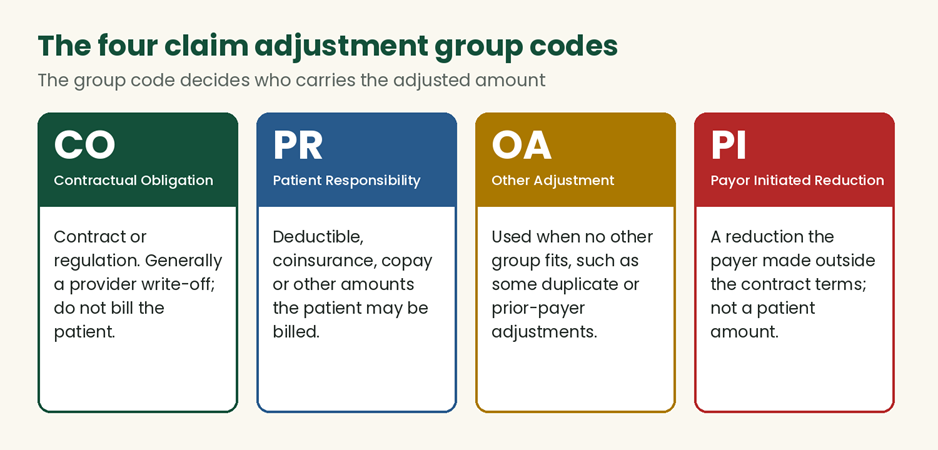
The same reason code can appear under different groups. A deductible, for example, is a patient amount, which is why patient-side codes are covered separately in our [LINK: guide to PR denial codes | /pr-denial-codes-explained/].
How to read a CO code on the ERA or EOB
Every adjustment on the ERA (electronic remittance advice, the 835 file) or paper EOB (explanation of benefits) has up to four parts: the group code, the CARC (Claim Adjustment Reason Code), an optional RARC (Remittance Advice Remark Code) and the dollar amount. The CARC wording is published in the X12 Claim Adjustment Reason Codes list.
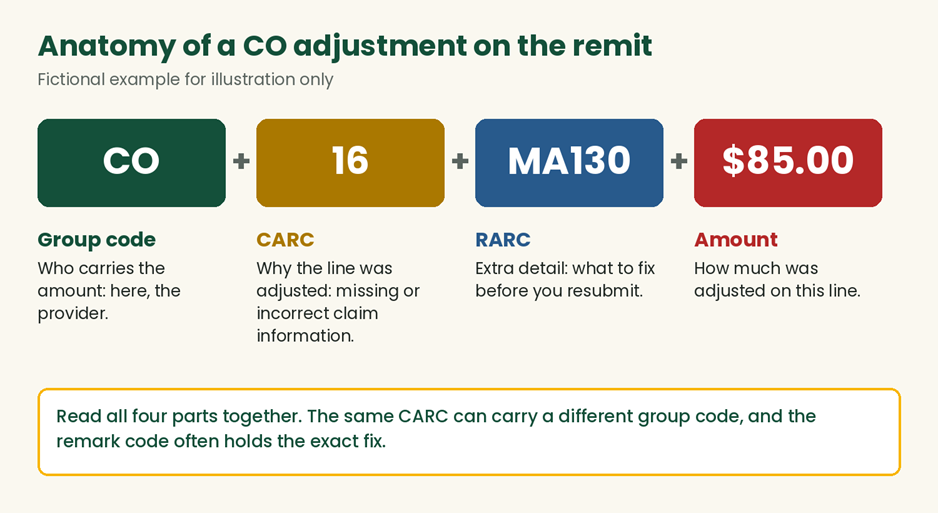
The CARC gives the broad reason and the RARC narrows it down. If you are unsure how the two work together, see [LINK: CARC vs RARC codes explained | /carc-vs-rarc-codes/].
CO Denial Codes List: Quick Reference
Use this table to identify the code, then jump to its summary and full guide below. “Usual action” is the most common route; the remark code and the record decide the final one.
| Code | What it means | Usual action |
| CO 4 | Procedure code is inconsistent with the modifier used. | Correct the modifier |
| CO 11 | Diagnosis is inconsistent with the procedure. | Correct the diagnosis or pointer |
| CO 16 | Claim lacks information or has a billing error. | Correct and resubmit |
| CO 18 | Exact duplicate claim or service. | Confirm; correct only if a valid repeat |
| CO 22 | Another payer may be primary (coordination of benefits). | Bill the primary payer first |
| CO 27 | Service was after coverage ended. | Find the active coverage |
| CO 29 | Time limit for filing has expired. | Appeal with proof, or adjust |
| CO 45 | Charge exceeds the fee schedule or contracted rate. | Contractual adjustment |
| CO 50 | Not deemed medically necessary by the payer. | Appeal with records |
| CO 96 | Non-covered charge; a remark code explains why. | Read the RARC, then act |
| CO 97 | Payment is included in another service already paid. | Check bundling edits |
| CO 109 | Not covered by this payer; send to the correct one. | Rebill the correct payer |
| CO 151 | Information does not support the units or frequency. | Recount units or appeal |
| CO 167 | The diagnosis is not covered. | Correct if documented, or appeal |
| CO 197 | Precertification or authorization was absent. | Appeal if auth existed, or adjust |
| CO 204 | Service is not covered under the current benefit plan. | Check waiver, or adjust |
| CO 236 | Procedure or modifier combination conflicts with another same-day procedure. | Review NCCI pairs and modifiers |
What Each CO Denial Code Means
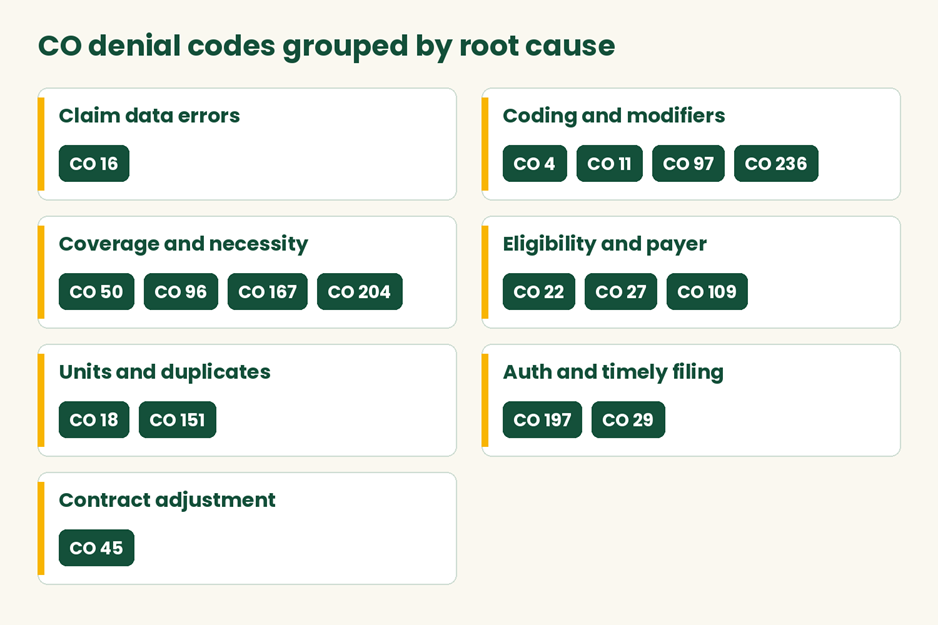
The codes below are grouped by root cause, so the same team can work related denials together.
Claim data and submission errors
CO 16: The claim is missing information or has a billing error, and at least one remark code tells you what. Fix the field named in the RARC and resubmit as the payer instructs. Read the full CO 16 missing information guide.
Coding and modifier errors
CO 4: The procedure code does not match the modifier, usually because a required modifier is missing, wrong or unsupported. Correct the modifier and resubmit. See how to fix a CO 4 modifier denial.
CO 11: The diagnosis does not support the procedure, often because of a diagnosis pointer or keying error. Point the line to the right documented diagnosis. Details are in our CO 11 diagnosis mismatch guide.
CO 97: The service is bundled into another one already paid. Check the pair against the CMS National Correct Coding Initiative edits, and add a modifier only when the record shows a truly separate service. See [LINK: the CO 97 bundling denial explained | /co-97-denial-code/].
CO 236: The procedure, or its modifier combination, is not compatible with another procedure on the same day under NCCI or workers’ compensation rules. Review the code pair and modifier use. See [LINK: how to resolve a CO 236 denial | /co-236-denial-code/].
Coverage and medical necessity
CO 50: The payer decided the service was not medically necessary. Appeal with notes and a letter of medical necessity, or check whether a Medicare ABN was signed. Our CO 50 medical necessity guide walks through it.
CO 96: The charge is non-covered, and the required remark code says why. Read the RARC first, because it decides the fix. See what a CO 96 non-covered charge means.
CO 167: The diagnosis billed is not covered for the service under an NCD, LCD or plan policy. Correct only if the chart documents a covered diagnosis. Read [LINK: the CO 167 diagnosis not covered guide | /co-167-denial-code/].
CO 204: The service, equipment or drug is not covered under the patient’s current benefit plan. Verify benefits before service and check whether a valid patient waiver exists. See [LINK: the CO 204 benefit exclusion guide | /co-204-denial-code/].
Eligibility and payer errors
CO 22: Another payer may be primary under coordination of benefits. Update the coverage order, bill the primary first, then send the secondary claim. See how to clear a CO 22 coordination of benefits denial.
CO 27: The service date falls after the patient’s coverage ended. Recheck eligibility, find any new coverage and follow your self-pay policy if none exists. Read the CO 27 terminated coverage guide.
CO 109: This payer or contractor is not responsible for the claim, such as a Medicare Advantage member billed to Original Medicare. Send it to the correct payer. See the CO 109 wrong payer denial.
Units and duplicates
CO 18: The payer sees an exact duplicate. X12 intends this code for the OA group in most cases, so you may also see OA 18. Do not resubmit a true duplicate; for a valid repeat service, use the right modifier. See the CO 18 duplicate claim guide.
CO 151: The payer does not accept the units or frequency billed, often because of a Medically Unlikely Edit. Recount the units against the record before deciding to correct or appeal. Read [LINK: the CO 151 units and frequency guide | /co-151-denial-code/].
Authorization and timely filing
CO 197: Required precertification or authorization was missing. Appeal with the authorization number if one existed, or ask about retro-authorization where the payer allows it. See how to handle a CO 197 authorization denial.
CO 29: The claim reached the payer after its filing limit. Appeal only with proof of timely submission, such as a clearinghouse acceptance report; otherwise, post the adjustment. Our CO 29 timely filing guide covers the proof payers accept.
Contract adjustments
CO 45: The charge is above the fee schedule or contracted rate, so the difference is written off. It is a normal adjustment, not a true denial, but compare the allowed amount with your contract to catch underpayments. See how CO 45 contractual adjustments work.
How to Work Any CO Denial: Correct, Appeal or Adjust
Whatever the code, the same short workflow keeps CO denials from aging.
- Read the whole line. Group code, CARC, RARC, amount and any policy ID.
- Check the record and the policy. Compare the chart, eligibility and authorization with what the payer says.
- Decide the route. Correct the claim if your data was wrong, appeal if the claim was right, or post the adjustment if the outcome is valid.
- Act within the deadline. Corrected claims must still meet timely filing, and appeals have their own windows set by each payer.
- Never move CO to the patient. Bill the patient only when the group code is PR or a valid waiver applies.
- Log the root cause. Track code, payer, provider and service so repeat denials point to a fix.
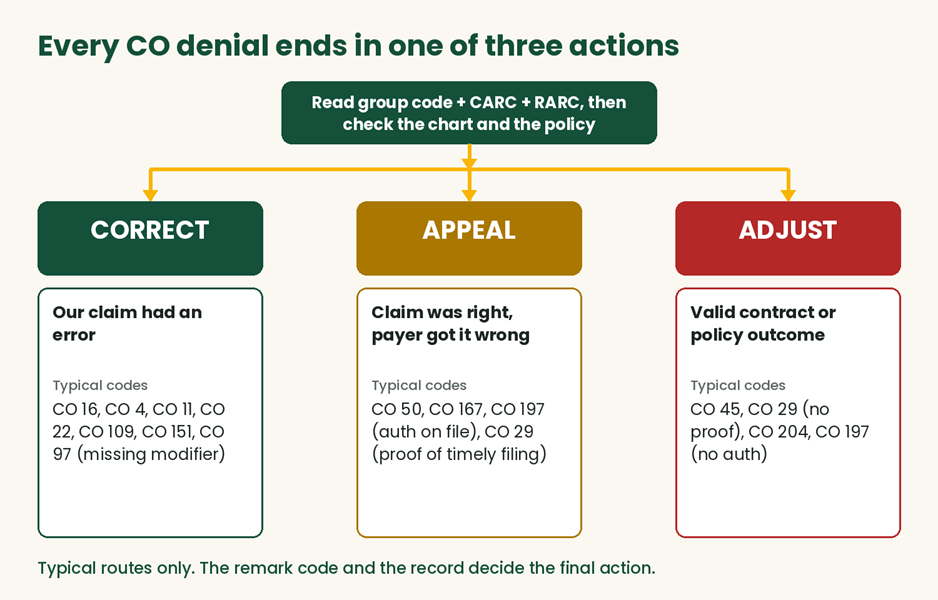
In short: data errors get a corrected claim, payer errors get an appeal, and valid contract or policy outcomes get an adjustment.
When a claim needs an appeal, follow the payer’s levels and attach proof for each point in dispute. Our [LINK: step-by-step guide to appealing a denied insurance claim | /how-to-appeal-a-denied-insurance-claim/] covers letters, attachments and follow-up.
Which CO Denials to Fix First
Not every denial deserves the same urgency. Work them in this order:
- Closest to a deadline. A correctable claim near its filing limit can become a CO 29 write-off.
- Highest dollar value. One surgical or infusion line can outweigh dozens of small office visits.
- Easiest to fix. CO 16, CO 4, CO 22 and CO 109 are usually quick corrections.
- Most frequent. A code that repeats every week points to a process gap worth fixing at the source.
For a look at the codes that drain the most revenue, read the denial codes costing practices the most. Aging denials also show up in your receivables, which is where strong A/R management keeps follow-up on schedule.
How to Prevent CO Denials Across the Revenue Cycle
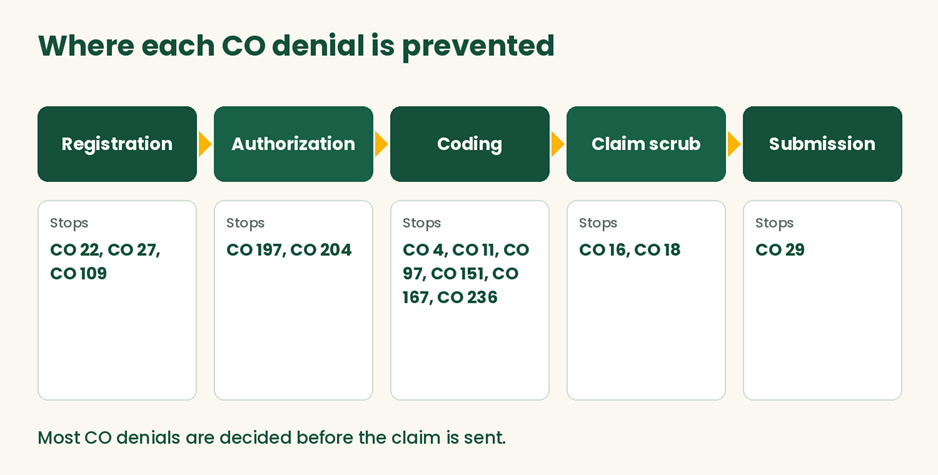
Most CO denials are decided before the claim leaves your office. Match each control to the stage where it works.
| Stage | Codes it prevents | Control that works |
| Registration | CO 22, CO 27, CO 109 | Real-time eligibility and coordination of benefits checks at every visit. |
| Authorization | CO 197, CO 204 | Benefit and authorization checks before scheduled services. |
| Coding | CO 4, CO 11, CO 97, CO 151, CO 167, CO 236 | Coding to the documentation, NCCI and unit edits, and LCD diagnosis lists. |
| Claim scrub | CO 16, CO 18 | Scrubber rules for required fields and duplicate checks before release. |
| Submission | CO 29 | Daily claim release and saved clearinghouse acceptance reports. |
Frequently Asked Questions About CO Denial Codes
Can I bill the patient for a CO denial?
No, not while the group code is CO. A CO amount is a contractual obligation the provider generally writes off. You can bill the patient only when the payer assigns the amount to PR (patient responsibility), which happens with deductibles, copays and coinsurance, or when a valid waiver, such as a signed Medicare ABN, was on file before the service.
What is the difference between CO and PR denial codes?
Both use the same reason codes, but the group code changes who pays. CO means the provider absorbs the amount under its contract or a regulation. PR means the amount is the patient’s to pay, such as a deductible or copay. Always read the group code before sending a statement.
Is CO 45 a denial?
Not really. CO 45 is the normal contractual write-off for the difference between your charge and the allowed amount. It appears on most paid claims. It only needs attention when the allowed amount is lower than your contract says, which points to an underpayment you can dispute.
Where can I find the official list of CO denial codes?
The full, current list of claim adjustment reason codes is published by X12, along with the group codes and remittance advice remark codes. Codes are added, changed and deactivated over time, so use the X12 list rather than an old printout when you are unsure of a code’s exact wording.
Why does the same denial show CO 18 on one remit and OA 18 on another?
X12 says reason code 18 should normally be paired with the OA group, except where state workers’ compensation rules require CO. Payers do not all follow that the same way, so both appear in practice. Either way, check whether the claim is a true duplicate or a valid repeat service.
Turn CO Denials Into Paid Claims
A clear CO denial codes list and meanings reference helps your team route each denial in minutes instead of days. If CO denials are piling up faster than your staff can work them, talk to our billing team about clearing the backlog and fixing the front-end gaps behind it.