
CO 109 means the payer that received the claim is not the one responsible for it, so the claim has to go to a different payer or Medicare contractor. It is not a ruling that the service is uncovered. The usual causes are a patient who moved to a Medicare Advantage or Medicaid managed care plan, an outdated insurance record or a claim routed to the wrong contractor. This guide covers the remark codes that come with CO 109, how to find the right payer, how to rebill without missing a deadline and how to stop wrong-payer claims at check-in.
| Key takeaways CO 109 means “Claim/service not covered by this payer/contractor. You must send the claim/service to the correct payer/contractor.”It is a routing problem, not a coverage verdict. The service may be fully payable by the right payer.The remark code (N418, N104 or N130) and a fresh eligibility check usually point to the correct payer.Bill the correct payer as a new claim and watch that payer’s filing limit, which usually runs from the date of service. |
What the CO 109 Denial Code Means
CO 109 is a claim adjustment reason code (CARC), one of the standard codes payers print on the remittance to explain a denial or adjustment. The full description of reason code 109 is “Claim/service not covered by this payer/contractor. You must send the claim/service to the correct payer/contractor.” The CO (contractual obligation) group code means the provider owns the denied amount, so the patient is not billed for it.
The key word is “this.” The payer is not judging the service. It is saying the claim belongs somewhere else. That makes CO 109 different from most codes in our [LINK: CO denial codes list and meanings | /co-denial-codes-list/], where the fix is usually on the claim itself. Here, the fix is usually in the patient’s insurance record.
Remark codes that come with CO 109
Read the remittance advice remark code (RARC) on the same line. It narrows down what kind of wrong payer you are dealing with.
| Remark code | What it says | What it usually means |
| N418 | Misrouted claim. See the payer’s claim submission instructions. | The claim went to the wrong payer or plan. For Medicare, often a Medicare Advantage or HMO enrollment on the date of service. |
| N104 | This claim/service is not payable under our claim’s jurisdiction area. | The right program, but the wrong Medicare contractor or region. |
| N130 | Consult plan benefit documents/guidelines for information about restrictions for this service. | Check the plan’s rules. For DME, Medicare may treat the item as part of an inpatient stay. |
Why Claims Go to the Wrong Payer
Almost every CO 109 starts at registration or in the billing system’s payer setup. These are the situations billers run into most often:
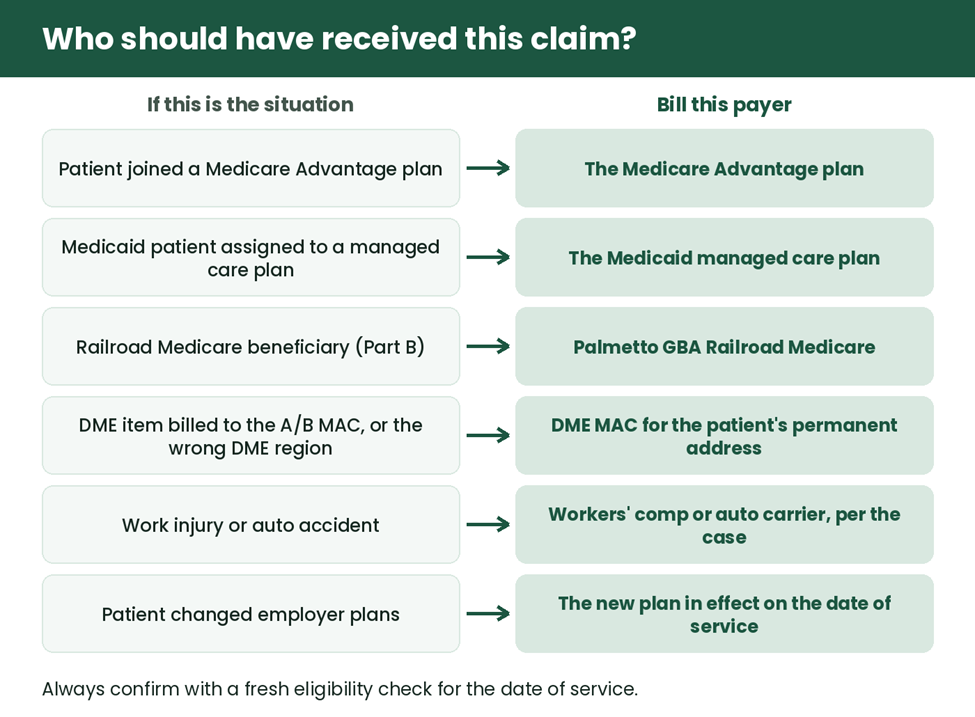
- The patient joined a Medicare Advantage plan. Once a patient enrolls, their claims go to the plan, not to the Medicare administrative contractor (MAC). CMS states this plainly in its Medicare Learning Network training: claims for patients in a Medicare Advantage plan should go to the patient’s plan.
- Medicaid managed care. A Medicaid patient assigned to a managed care organization is billed to that plan, not to the state’s fee-for-service program, and the reverse.
- Railroad Medicare. Part B claims for Railroad Medicare beneficiaries go to Palmetto GBA Railroad Medicare, as its Railroad Medicare claims page explains, not to your local MAC.
- The wrong Medicare contractor. Each MAC covers a defined geographic jurisdiction, listed on the CMS Who Are the MACs page. Durable medical equipment (DME) claims go to a DME MAC, chosen by the beneficiary’s permanent address, not to the A/B MAC.
- Work injuries and accidents. Services tied to a workers’ compensation or auto claim may belong with that carrier.
- A plan change nobody captured. The patient changed jobs or plans, and the old card is still on file. If the old plan says coverage ended, you will see a CO 27 denial for coverage that has ended rather than CO 109.
- Payer ID mapping errors. The right insurance is on file, but the billing system or clearinghouse sends it to the wrong payer ID.
CO 109 vs CO 22 vs CO 27
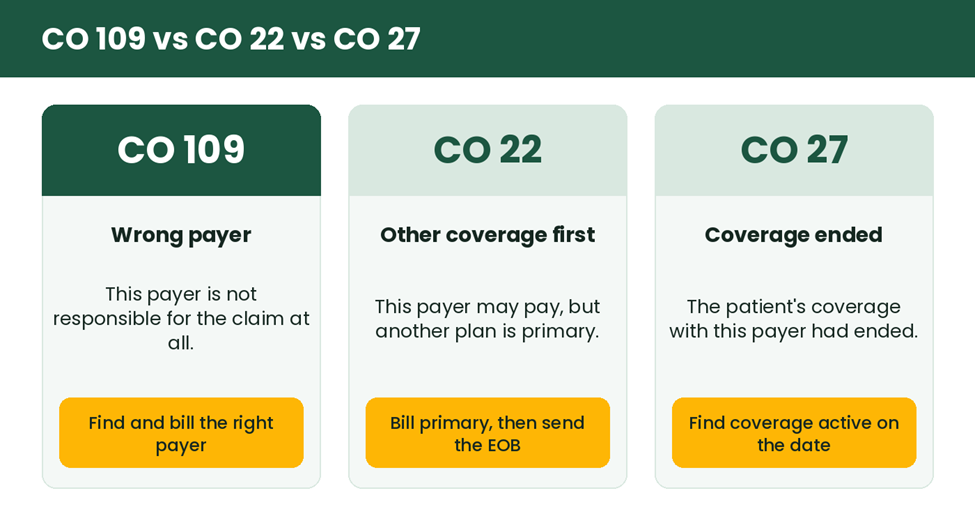
Three eligibility-related codes get mixed up on a busy remit, and each needs a different fix. When the payer may still pay but another plan should go first, the remittance shows a CO 22 coordination of benefits denial instead.
| Code | What the payer is saying | First move |
| CO 109 | We are not responsible for this claim. Send it to the correct payer. | Find the right payer and bill it |
| CO 22 | Another plan may be primary under coordination of benefits. | Bill the primary, then send its EOB here |
| CO 27 | The patient’s coverage with us had ended before the date of service. | Find the coverage active on that date |
How to Fix a CO 109 Denial Step by Step
Do not send the same claim back to the same payer. It will deny again. The goal is to find who should have received it.
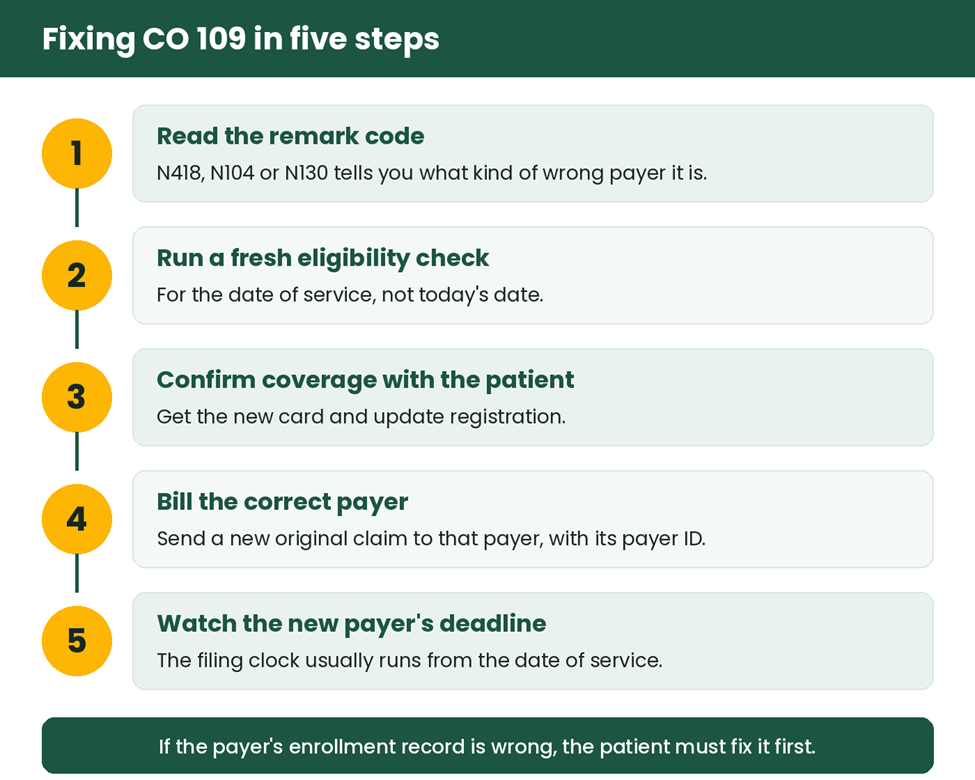
Diagram summary: read the remark code, run eligibility for the date of service, confirm the coverage with the patient, bill the correct payer and track that payer’s filing deadline.
- Read the remark code and the denial details. For Medicare, the MAC portal often shows the other plan. Noridian, for example, tells providers in its reason code 109 with N418 guidance to check the expanded denial details for the HMO plan’s name, address and plan ID.
- Run a fresh eligibility check for the date of service. Use the payer portal or an electronic 270/271 inquiry. Our walkthrough of the [LINK: insurance eligibility verification process | /insurance-eligibility-verification-process/] covers what to look for in the response.
- Confirm the coverage with the patient. Call the patient, get a copy of the current card and ask about any plan changes, work injuries or accidents. Update the registration record.
- Bill the correct payer. Send a new original claim to the right payer, with that payer’s payer ID, member ID and any referral or authorization it requires. A corrected claim to the first payer will not help, because that payer is not responsible.
- Watch the new payer’s filing limit. The clock usually runs from the date of service, not from the CO 109 date. Keep the first submission and the denial on file. Some payers will consider proof that the claim was sent on time to another payer, but rules vary, and a late claim can come back as a CO 29 timely filing denial.
When the payer’s record is wrong
Sometimes the patient was not in the plan the payer shows. Medicare enrollment records can only be fixed by the beneficiary or their representative, so the patient has to contact the plan, or Social Security for an address problem. Once the record is corrected for the date of service, ask the MAC to reopen the claim or file a redetermination with the supporting proof.
Example: a patient who switched to Medicare Advantage
A patient who had Original Medicare enrolled in a Medicare Advantage plan effective January 1. At a February visit, the front desk used the old Medicare card on file. The claim went to the MAC and came back CO 109 with N418.
The biller checked the portal, found the Medicare Advantage plan name in the denial details, confirmed the new card with the patient and billed the plan directly. Because the plan’s own filing limit applied, the claim went out the same week. The lasting fix was a check-in rule: ask every Medicare patient whether their coverage changed, especially early in the year.
How to Prevent CO 109 Denials
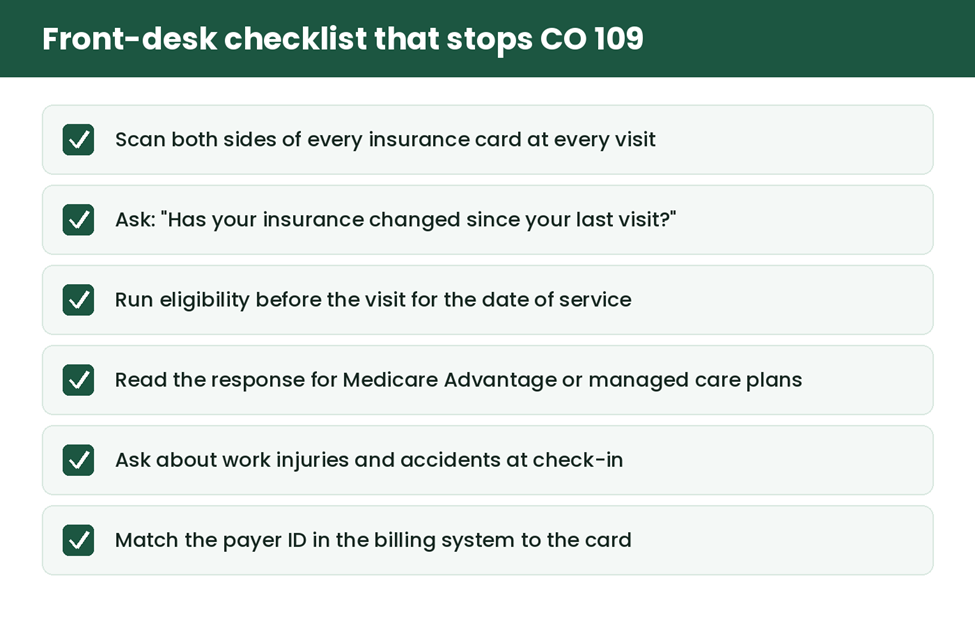
Wrong-payer denials are among the most preventable. Most of the work happens before the visit.
- Scan both sides of the insurance card at every visit, not just the first one.
- Ask every patient whether their insurance has changed, especially in January and after open enrollment.
- Run eligibility before the visit for the date of service, using the [LINK: 270/271 eligibility transaction | /270-271-eligibility-transaction/] or the payer portal, and read the response for Medicare Advantage or managed care plan details.
- Ask about work injuries and accidents at check-in, and flag those accounts.
- Keep payer IDs in your billing system and clearinghouse matched to the card, and review them when payers merge or change IDs.
- Track CO 109 by payer and by registration staff each month to find the source.
Get Help With Wrong-Payer Denials
If CO 109 keeps showing up, the gap is usually in eligibility checks or payer setup, not in coding. Our denial management services team can trace your wrong-payer denials back to the source, rebill them to the right payers and help your front desk close the gap.
Frequently Asked Questions
Does CO 109 mean the service is not covered?
No. CO 109 only says this payer is not the one responsible. The same service may be fully covered by the patient’s correct plan, such as a Medicare Advantage plan, a Medicaid managed care plan or a workers’ compensation carrier. Treat it as a routing problem: find the right payer, bill it and track the claim to payment.
Can I bill the patient for a CO 109 denial?
Not because of CO 109 alone. The code says another payer is responsible, so the next step is finding that payer. If verification shows the patient truly had no coverage on the date of service, the balance follows your financial policy and any rules in your payer contracts and state law. Explain the situation to the patient before sending a statement.
Does the timely filing clock restart after CO 109?
Usually not. Most payers measure their filing limit from the date of service, so the time spent at the wrong payer counts against you. Some payers accept proof that the claim was sent on time to another payer, but this varies by contract and provider manual. Rebill quickly and keep the original submission records.
Can I appeal a CO 109 denial?
Yes, if the payer is wrong about who covers the patient. Gather proof, such as an eligibility response or the patient’s enrollment letter, and use the payer’s reconsideration or redetermination route, covered in [LINK: how to appeal a denied insurance claim | /how-to-appeal-a-denied-insurance-claim/]. If the payer’s record is right, an appeal will not help; bill the correct payer instead.
What does remark code N418 mean with CO 109?
N418 means “Misrouted claim. See the payer’s claim submission instructions.” It confirms the claim went to the wrong place. With Medicare, it often appears when the patient was enrolled in a Medicare Advantage or other Medicare health plan on the date of service, so the claim belongs with that plan instead of the MAC.
Sources: X12 Claim Adjustment Reason Code and Remittance Advice Remark Code lists; Noridian Medicare denial code resolution guidance for reason code 109; CMS Medicare Learning Network; CMS Medicare Administrative Contractor jurisdiction listings; Palmetto GBA Railroad Medicare. This article is general billing information, not legal advice. Payer rules vary, so follow each payer’s provider manual.