
The CO 45 denial code means the charge you billed was higher than the payer’s fee schedule, maximum allowable amount or contracted rate, so the payer adjusted the difference off the claim. In most cases it is a routine contractual write-off, not a true denial, and the patient cannot be billed for it. This guide shows how to read CO 45 on a remittance, when it signals a real problem, and how to fix and prevent it.
| Key takeaways CO 45 is a claim adjustment reason code, and the CO group code means the provider, not the patient, owns the balance.On most paid claims it is a normal gap between your charge and the payer’s allowed amount.It is a red flag when the whole charge is adjusted or the allowed amount does not match your contract.Post correct adjustments as write-offs, and dispute only genuine underpayments. |
What the CO 45 Denial Code Means
CO 45 means the payer reduced your billed charge to its allowed amount. CARC (claim adjustment reason code) 45 describes the reduction, and the CO (contractual obligation) group code says the provider absorbs it. The payer pays on the allowed amount, so the difference is a write-off, not a balance the patient owes.
CO 45 is one of the most common codes in its group.
Our [LINK: CO denial codes list and meanings | /co-denial-codes-list/] compares it with the rest.
X12, the standards body that maintains these codes, describes CARC 45 as a charge that exceeds the fee schedule, maximum allowable amount or contracted or legislated fee arrangement. Its claim adjustment reason code list says the code may be used only with group code PR or CO, depending on liability, and that the adjustment cannot equal the total charge. That last point matters later.
How to Read CO 45 on a Remittance
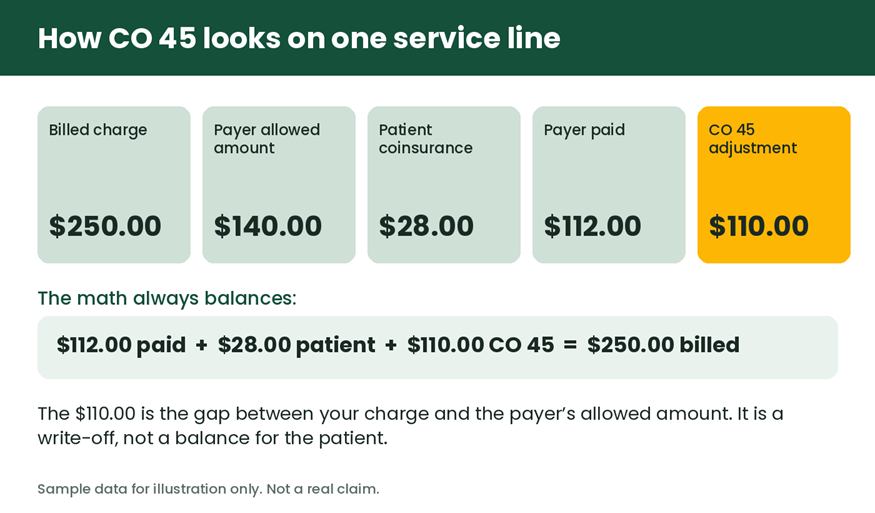
Open one service line on the electronic remittance advice (ERA), the electronic version of the explanation of benefits (EOB). If the two documents still blur together, [LINK: ERA vs EOB | /era-vs-eob/] explains how they differ. Each line shows the billed charge, the allowed amount, the payment, any patient share and every adjustment with its group code. Here is a fictional example.
| Line item (fictional sample) | Amount |
| Billed charge | $250.00 |
| Payer allowed amount | $140.00 |
| Patient coinsurance (PR 2) | $28.00 |
| Payer paid | $112.00 |
| CO 45 adjustment (billed minus allowed) | $110.00 |
In this example the payer allowed $140, paid 80 percent ($112) and assigned 20 percent ($28) to the patient as coinsurance. The remaining $110 is the CO 45 write-off. Payment plus patient share plus adjustments equals the billed charge. If a line does not balance, something else is wrong.
When CO 45 Is Normal and When It Is a Red Flag
A CO 45 on a paid line with a non-zero allowed amount is normal. Most practices bill from a charge master that sits above what any payer pays, so nearly every claim carries one. Look closer when you see any of these:
- The entire charge is adjusted. The X12 usage note says the adjustment cannot equal the total charge, so a zero-payment line with CO 45 is usually a mislabeled denial. The real reason often sits in a companion remark code.
- The allowed amount is below your contract. This is an underpayment, and it will not fix itself.
- The payer applied the wrong plan or network status. An in-network claim priced as out-of-network produces a lower allowed amount.
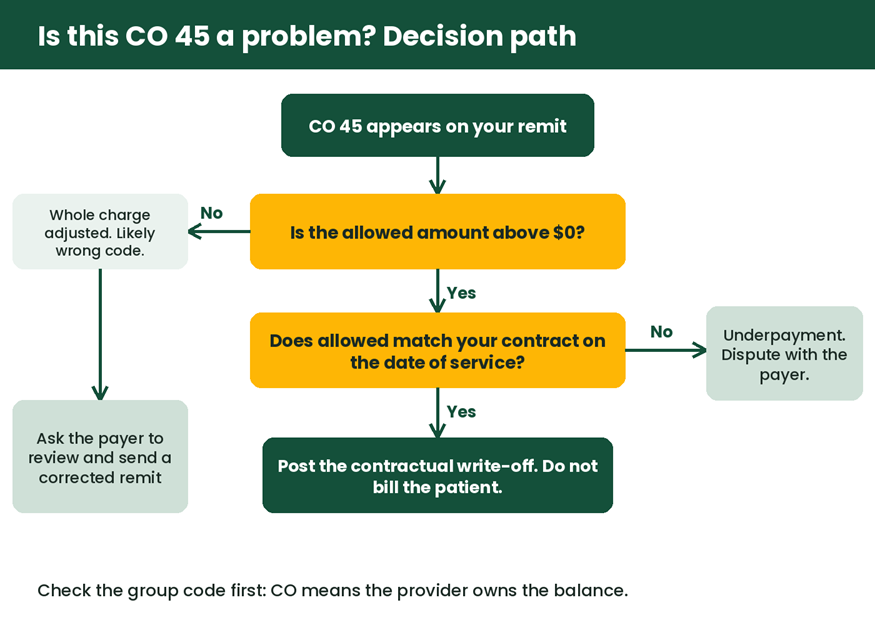
Diagram summary: check whether the allowed amount is above zero, then whether it matches your contract, then post the write-off or dispute the payment.
How to Fix and Handle a CO 45 Step by Step
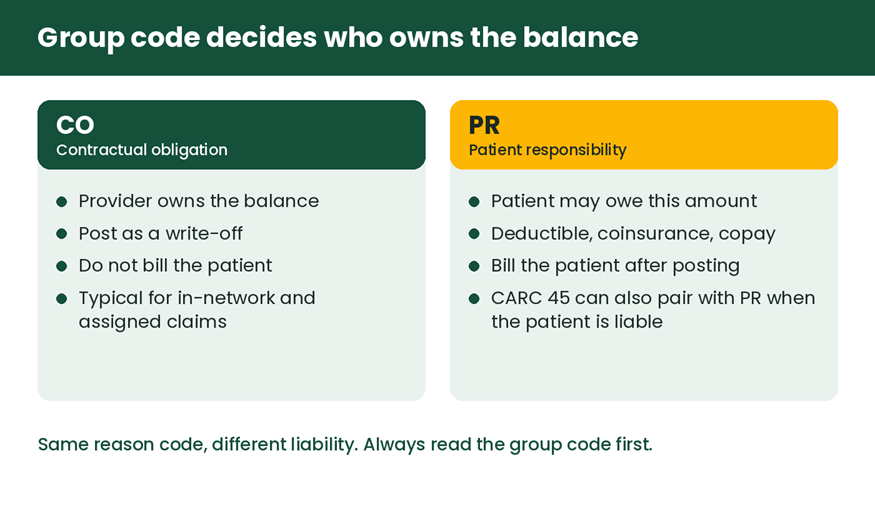
- Confirm the group code. CO means the provider owns the balance. PR means the patient may owe it.
- Check the line math. Billed charge minus allowed amount should equal the adjustment, and everything should add up to the charge.
- Compare the allowed amount with your contract. Use the rate in effect on the date of service. For Medicare Part B, the CMS Physician Fee Schedule look-up tool shows fee schedule amounts by code and locality.
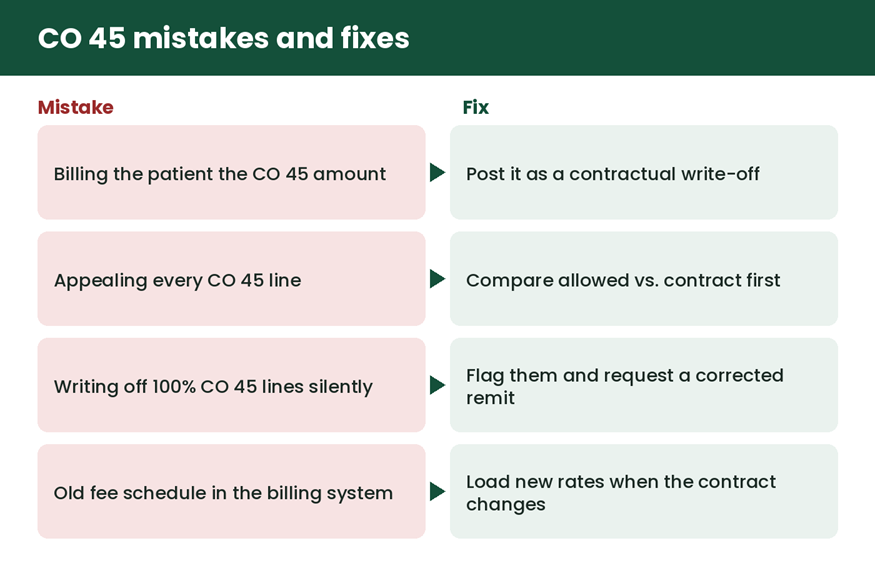
- Post the adjustment if the allowed amount is correct. Record it as a contractual write-off and move on.
- Dispute the payment if it is too low. Send the remit, the claim details and the contract rate to the payer, following its reconsideration process. Track the dispute in your A/R follow-up queue so underpayments are not forgotten.
- Query lines where the whole charge was adjusted. Call the payer, ask for a review and request a corrected remittance with the accurate reason code.
Sample dispute wording: “Claim [claim number], date of service [date], CPT [code]. The remittance shows an allowed amount of $[amount] with CO 45. Our contract with [payer], effective [date], lists $[contract rate] for this code. Please review and reprocess at the contracted rate.”
Can You Bill the Patient for CO 45?
No, not when CO 45 appears with the CO group code. CO means the provider owns the balance under the payer contract, so the difference between your charge and the allowed amount is a write-off. Patient responsibility applies only to amounts the payer reports with PR group codes, such as deductible, coinsurance or copay.
For Medicare, Noridian’s Part B guidance on assignment explains that a provider who accepts assignment treats the Medicare-approved amount as payment in full, while the deductible and coinsurance can still be collected. Commercial rules depend on your contract and state law, so check the payer’s provider manual.
CO 45 vs Similar Codes
Several codes get mixed up with CO 45. A duplicate submission belongs to [LINK: duplicate claim denials | /co-18-denial-code/], and a service bundled into another line falls under [LINK: CO 97 bundling denials | /co-97-denial-code/].
| Code | Plain meaning | Typical first step |
| CARC 45 | Charge exceeds fee schedule or contracted rate | Check the math, post the write-off |
| CARC 18 | Exact duplicate claim or service | Confirm the original claim status |
| CARC 97 | Benefit is included in the payment for another service | Review bundling and the related line |
| CARC 50 | Not deemed a medical necessity by the payer | Review documentation and appeal rights |
A medical necessity denial is a different problem. Our guide to the CO 50 denial code covers the fix.
How to Prevent CO 45 Problems
- Load every payer’s fee schedule into your practice management system and update it whenever a contract changes.
- Review the rate exhibit when a contract is signed or renewed. Our overview of payer contracting shows what to look for.
- Verify plan and network status at the eligibility check, before the visit.
- Run a monthly report of expected versus allowed amounts by payer and CPT code, and investigate patterns.
- Flag any line where CO 45 equals the full charge.
Do not lower your charges just to shrink the CO 45 amount. The charge master and the contracted rates are separate decisions.
Get Help With CO 45 and Contract Variances
If CO 45 variances keep piling up, or you are not sure payments match your contracts, our team can review a sample of your remittances and show where money is slipping. Learn more about our denial management services.
Frequently Asked Questions
Is CO 45 a denial?
Usually no. CO 45 is most often a contractual adjustment on a paid line, where the payer pays its allowed amount and writes off the rest. It acts like a denial only when the payer adjusts the entire charge and pays nothing, which is a reason to ask the payer to review the claim and correct the reason code.
Should I appeal a CO 45?
Only if the allowed amount is wrong. If it matches your contract or the fee schedule, post the write-off and move on. If it is lower, send a reconsideration or underpayment dispute with the contract rate, the remittance and the claim details, following the payer’s process and filing limits in its provider manual.
What is the difference between CO 45 and PR 45?
CARC 45 describes the reason, and the group code assigns liability. With CO, the provider absorbs the amount. With PR, the patient is responsible. X12 allows CARC 45 with either group code, depending on liability, so read the group code before posting the adjustment or billing anyone.
Why did the payer adjust my entire charge with CO 45?
CARC 45 is meant for a reduction to an allowed amount, not a full write-off. Payers sometimes apply it to the whole charge when a service is excluded or information is missing. Check the remark codes on the line, call the payer and request a corrected remittance so you can track the claim properly.
Sources: X12 Claim Adjustment Reason Code list, Noridian JE Part B assignment guidance and the CMS Physician Fee Schedule look-up tool. This article is general education, not legal or payer-specific advice; your contracts and each payer’s provider manual govern how claims are processed.