
CO 18 means the payer believes it already received this exact claim or service, so it denies the second copy. The fix depends on what happened to the first claim: if it was paid, nothing more is owed, and if it was denied, needs correcting or covers a genuinely repeated service, you fix the original instead of sending it again. This guide explains how payers spot duplicates, how to sort each CO 18 into the right path, which modifiers protect real repeat services and how to stop duplicates at the source.
| Key takeaways CO 18 is reason code 18, “Exact duplicate claim/service,” and it denies the second copy of a claim the payer already has.Look up the original claim before anything else. Its status decides the fix.Corrections go on a replacement claim (frequency code 7), or a reopening for Medicare Part B, never on a brand-new claim.Real repeat services need a modifier such as RT/LT, 76, 77 or 91, backed by the medical record. |
What the CO 18 Denial Code Means
CO 18 is a claim adjustment reason code (CARC), the standard code a payer prints on the remittance to explain why a line was paid differently than billed. Reason code 18 reads “Exact duplicate claim/service.” The group code in front of it says who owns the balance. CO (contractual obligation) puts it on the provider, so the patient cannot be billed for the denied copy.
CO 18 belongs to the same family as the other contractual codes in our [LINK: CO denial codes list and meanings | /co-denial-codes-list/], but it behaves differently from most of them. A CO 18 rarely means money is lost. It usually means the money is already paid, still in process or stuck on the first claim.
CO 18 vs OA 18 and remark code N522
The same reason code can arrive with a different group code. Noridian, a Medicare administrative contractor (MAC), reports Part B duplicates as OA 18 (other adjustment) in its exact duplicate claim/service guidance, while many commercial payers send CO 18. You handle both the same way.
You may also see remittance advice remark code (RARC) N522, “Duplicate of a claim processed, or to be processed, as a crossover claim.” It means the claim matched one that Medicare already forwarded, or will forward, to the secondary payer.
How Payers Decide a Claim Is a Duplicate
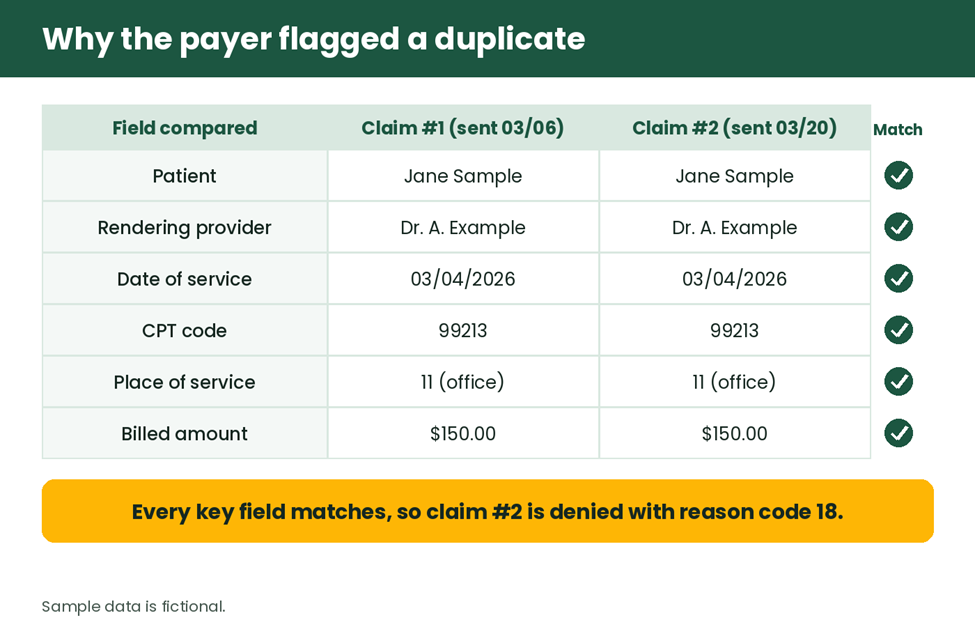
Payer systems compare each new claim with the claims already paid or in process for the same patient. When the key fields match, the new claim is held or denied. The exact fields vary by payer, but they usually include:
- Patient and member ID
- Rendering or billing provider
- Date of service
- Procedure code and modifiers
- Place of service
- Billed amount and units
A difference in a single field, such as a modifier, can decide whether the line pays or comes back as CO 18.
Common Causes of CO 18 Denials
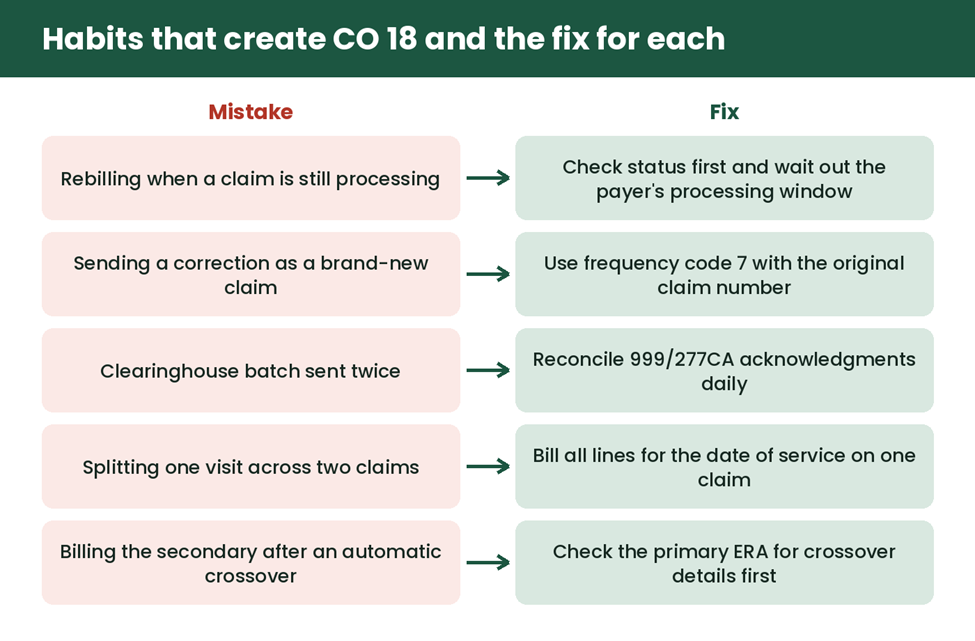
Most duplicates are created by the billing workflow, not by the visit itself. These are the causes billers run into most often:
- Rebilling too soon. Staff or the billing system resubmit a claim that is still processing. Medicare contractors ask providers to wait before rebilling, and Noridian, for example, suggests allowing 30 days from the first submission.
- Corrections sent as new claims. A fixed claim sent with frequency code 1 (original) looks like a second copy of the first one.
- Double transmission. A clearinghouse or practice management batch goes out twice.
- Repeat services without a modifier. A second X-ray, a repeat lab test or a procedure on both sides billed on two lines with nothing to show they differ.
- Split claims. Lines for the same date of service sent on two claims instead of one.
- Crossover overlap. The office bills the secondary payer after Medicare has already crossed the claim over. If the secondary payer denies for coordination of benefits instead, that is a CO 22 coordination of benefits denial, which needs a different fix.
How to Fix a CO 18 Denial Step by Step
Do not resend the claim. A third copy will deny the same way and burns time against the filing deadline. Work the original claim instead.
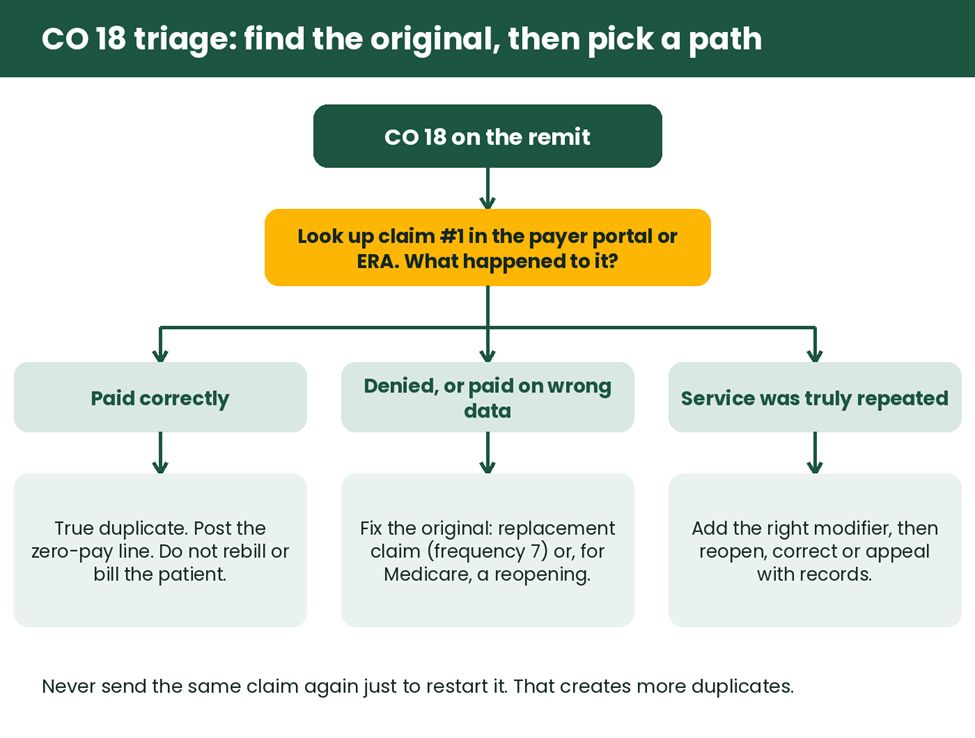
Diagram summary: look up the original claim, then post a true duplicate, correct an original that was wrong, or add a modifier and documentation for a service that was truly repeated.
- Find the original claim. Search the payer portal, your electronic remittance advice (ERA) files and clearinghouse reports by patient and date of service. If you need help pulling the right lines out of an 835 file, see [LINK: how to read an ERA 835 | /how-to-read-an-era-835/].
- Confirm its status. Paid, partly paid, denied or pending. If the original is still pending, wait for it to finish. Nothing else is needed.
- Paid correctly? It is a true duplicate. Post the CO 18 line as a zero-pay adjustment on the duplicate and close it. Do not bill the patient.
- Denied or paid on wrong data? Correct the original. Most commercial and Medicaid plans want a replacement claim with frequency code 7 and the payer’s original claim number in Box 22 of the CMS-1500 (or the matching 837P field). Our guide to [LINK: corrected claim frequency code 7 | /corrected-claim-frequency-code-7/] walks through the fields.
- Medicare Part B? Use a reopening. Clerical errors such as a wrong date, code or modifier are fixed through a reopening, which Noridian accepts within one year of the initial determination under its Part B reopening rules.
- Truly repeated? Prove it. Add the right modifier and the supporting notes, then use the payer’s correction or reconsideration route. For Medicare, a redetermination must be filed within 120 days of receiving the initial determination, as set out on the CMS first-level appeal page.
Not sure whether a fix belongs on a corrected claim or in an appeal? Our comparison of [LINK: corrected claim vs appeal | /corrected-claim-vs-appeal/] explains when each route applies.
Example: a repeat X-ray denied as a duplicate
A patient has a chest X-ray in the morning and a second chest X-ray that afternoon after a line placement. The office bills the same CPT code on two separate claims for that date, with no modifier. The first claim pays. The second comes back CO 18.
The fix: confirm the first claim paid, then correct the second line with modifier 76, because the same physician read both films, and send it through the payer’s correction route with both reports. The times and reasons in the record are what support payment, not the modifier alone. Next time, bill both lines on one claim with the modifier on the second line.
Modifiers That Show a Service Was Repeated
When a service is legitimately performed more than once, a modifier tells the payer the second line is not a copy. Use one only when the medical record supports the repeat.
| Modifier | When to use it |
| RT / LT | Same procedure on the right and the left side |
| 50 | Bilateral procedure, billed the way the payer’s bilateral rules require |
| 76 | Same procedure repeated the same day by the same physician or qualified health care professional |
| 77 | Same procedure repeated the same day by a different physician or qualified health care professional |
| 91 | Medically necessary repeat of the same clinical lab test the same day, not a rerun for a specimen or equipment problem |
| JW | Discarded amount of a single-dose drug, billed on its own line |
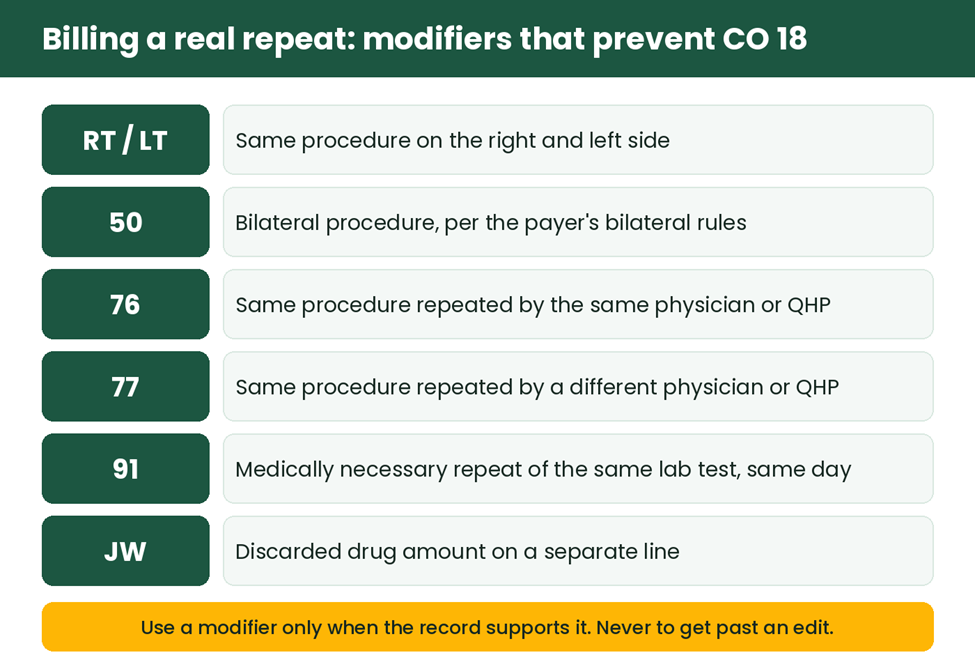
Repeat modifiers are not a way around bundling edits. If the payer says one service is included in another, you are dealing with a [LINK: CO 97 bundling denial | /co-97-denial-code/], not a duplicate.
CO 18 vs Similar Denial Codes
A few codes get confused with CO 18 on a busy remit. If the payer says the claim is missing data, you are looking at a CO 16 missing information denial, which is fixed by adding the data, not by proving the service is unique.
| Code | What it means | First move |
| CO 18 | Exact duplicate of a claim or service the payer already has | Find the original claim and its status |
| CO 16 | Claim lacks information or has submission errors | Add the missing data per the remark code |
| CO 97 | Service is included in another service already paid | Review bundling edits and documentation |
| CO 22 | Another plan may be primary | Update coordination of benefits and rebill the right payer |
How to Prevent Duplicate Claim Denials
- Check claim status in the portal or phone system before any rebill, and set a rule that nobody resubmits until the payer’s processing window has passed.
- Turn off automatic rebilling in your practice management system, or set it to a long enough interval.
- Reconcile clearinghouse acknowledgments (the 999 and 277CA reports) every day so a double batch is caught before payers process it.
- Bill all lines for one date of service on a single claim.
- Send every correction as a replacement (frequency 7) or a void (frequency 8) with the original claim number.
- Read the primary ERA for crossover details before billing a secondary payer.
- Track CO 18 by payer and by staff member each month. A spike usually points to one workflow.
Get Help With Duplicate Denials
If CO 18 keeps landing on your remits, the cause is usually one or two habits in the billing workflow. Our denial management services team can review your recent duplicate denials, trace each one back to its original claim and show you where the repeats start.
Frequently Asked Questions
Can I bill the patient for a CO 18 denial?
No. The CO group code makes the provider responsible for the denied line, and a duplicate is not a new service. Any patient balance comes from the original claim’s remittance, such as a deductible or coinsurance. Collect that amount only, and only after the original claim has finished processing.
How long should I wait before resubmitting a claim?
Wait until the payer has had time to process the first claim and you have checked its status. Medicare contractors publish their own windows; Noridian, for example, asks for 30 days from the first submission. Keep the filing deadline in view while you wait, because a missed deadline brings a CO 29 timely filing denial instead.
Can I appeal a CO 18 denial?
Yes, when the payer matched two claims that were really different services, such as a repeat procedure or a different body side. Send the records, the modifier and a short explanation. For Medicare, request a redetermination; for commercial plans, follow the plan’s reconsideration steps, covered in [LINK: how to appeal a denied insurance claim | /how-to-appeal-a-denied-insurance-claim/]. If the original was simply paid, there is nothing to appeal.
Why did my corrected claim deny as a duplicate?
Usually because it went out as a new claim. Without frequency code 7 and the payer’s original claim number, the payer cannot tell it is a replacement, so it compares it with the first claim and finds a match. Replace or void through the payer’s correction process instead, and use a reopening for Medicare Part B.
What is the difference between CO 18 and OA 18?
The reason is the same: an exact duplicate claim or service. Only the group code differs. CO marks a contractual adjustment the provider absorbs, while OA (other adjustment) is used by some payers, including Medicare contractors such as Noridian, for adjustments outside the contractual and patient categories. The fix is identical for both.
Sources: X12 Claim Adjustment Reason Code list; Noridian JE Part B reason code guidance; Noridian JF Part B reopening guidance; CGS Medicare Part B duplicate denial guidance; CMS Medicare fee-for-service appeals guidance. This article is general billing information, not legal advice. Payer rules vary, so follow each payer’s provider manual.