
The CO 29 denial code means the payer says the time limit for filing the claim has expired. The provider is responsible for the amount, and this is one of the hardest denials to reverse. The only strong defenses are proof that the claim was filed on time or a payer-allowed exception. This guide shows how to check both and how to stop it from happening. CO-29 is one of the common claim denial codes practices see.
What the CO 29 Denial Code Means
CO 29 reads “the time limit for filing has expired.” CO is the group code, so the provider carries the loss. 29 is the claim adjustment reason code (CARC). Medicare often pairs it with remark code N211, “You may not appeal this decision.” A remark code (RARC) adds detail to the CARC.
Timely filing is the deadline for the payer to receive a claim. Original Medicare sets it at one calendar year from the date of service. Commercial payers and state Medicaid programs set their own limits in the contract and provider manual, so check each one. For limits by payer,
see [LINK: timely filing limits by insurance company | /timely-filing-limits-by-insurance-company/].
Why CO-29 Denials Happen
- Late first submission: charges were held for coding, documentation or a missing provider signature.
- Rejected claims never fixed: the clearinghouse or payer rejected the claim and nobody reworked it.
- Wrong payer or old coverage: the claim went to the wrong plan, then the right one after the limit.
- Late corrected or secondary claim: a corrected claim or secondary claim missed its own limit.
- Wrong date of service: a typo on the claim makes an on-time claim look late.
Where the Filing Clock Runs Out
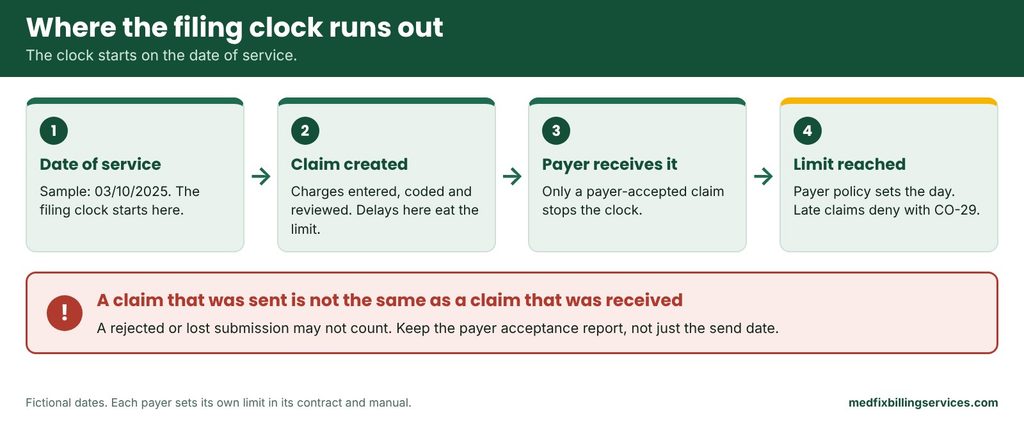
The clock usually starts on the date of service and stops when the payer receives a clean claim. Delays before submission use up the limit. The sample below uses fictional dates.
How to Fix a CO-29 Denial Step by Step
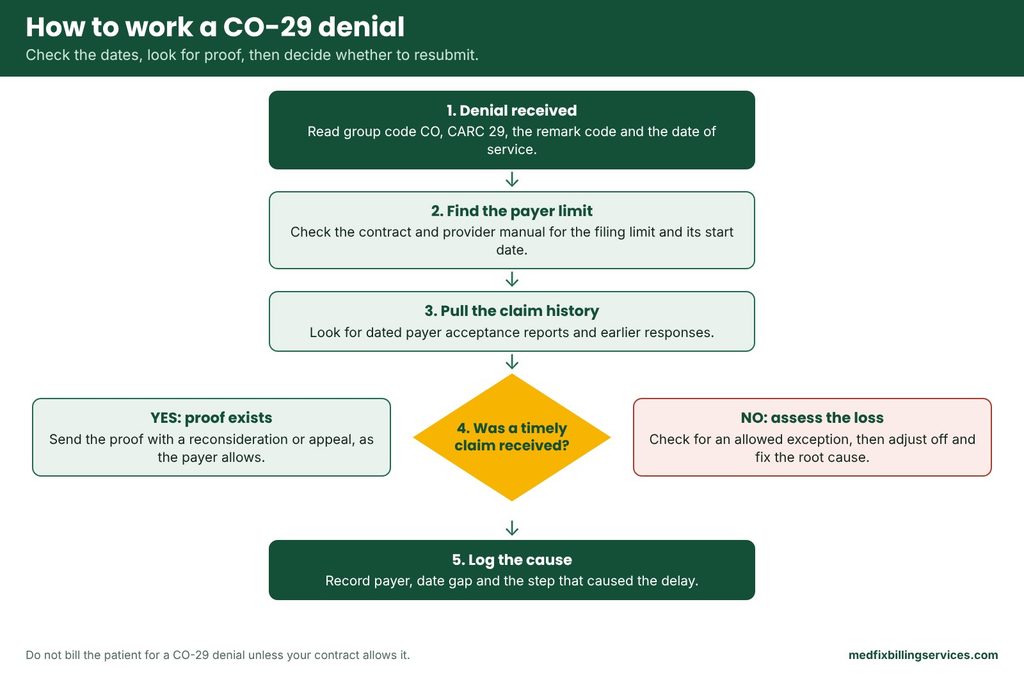
- Read the remit line: group code, CARC, remark code, date of service and billed date.
- Confirm the date of service on the claim matches the medical record. A wrong date can create a false late denial. If it was wrong, submit a new claim with the correct date.
- Find the payer’s filing limit and when its clock starts in the contract and provider manual.
- Search your system for any earlier submission, including clearinghouse reports, rejections and prior remits.
- If you can prove the payer received a timely claim, send it with a reconsideration or appeal request, following the payer’s process.
- If you cannot, check whether the payer allows an exception. If none applies, adjust off the balance and log the cause.
What Counts as Proof of Timely Filing
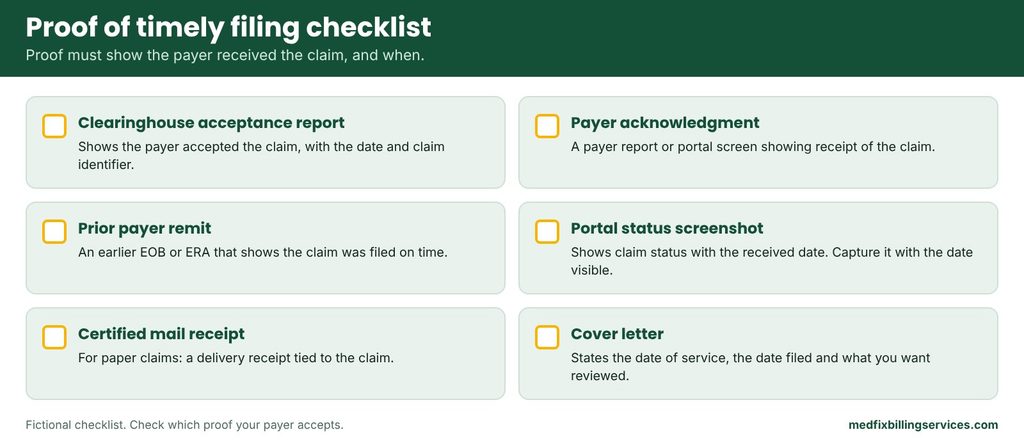
Proof must show the payer received the claim and when. A billing system “sent” date is weak evidence. Payer-accepted reports are strong. Accepted proof varies by payer, so check the provider manual. For a deeper walkthrough,
see [LINK: how to prove timely filing | /how-to-prove-timely-filing/].
Sample timely filing appeal wording (fictional data)
Re: Claim SAMPLE-0029, date of service 03/10/2025. Our records show this claim was accepted by your system on 04/02/2025. The enclosed acceptance report shows the date and claim identifier.
The remittance dated 08/15/2025 denied the claim as filed after the time limit. We ask you to review the proof and reprocess the claim. Enclosures: acceptance report, portal screenshot, remittance.
Can You Appeal a CO-29 Denial?
Sometimes. With proof of timely receipt, a reconsideration or appeal is worth filing. Without proof, many payers allow no appeal. Original Medicare tells providers they cannot appeal a true timely filing denial, though a government administrative error or circumstances outside your control can support a review. Read the payer’s policy before you spend time on it.
Do not bill the patient for a CO-29 denial unless your contract specifically allows it. A late claim is generally the provider’s loss.
CO-29 vs Similar Denial Codes
| Code | What the payer is saying | Usual fix |
| CO-29 | The time limit for filing has expired | Prove timely receipt or adjust off |
| CO-16 | Claim lacks information or has a billing error | Correct the data: [LINK: CO-16 denial code | /co-16-denial-code/] |
| CO-18 | Duplicate claim or service | Check for a prior claim: [LINK: CO-18 denial code | /co-18-denial-code/] |
| CO-197 | Authorization absent | Find the approval: [LINK: CO-197 denial code | /co-197-denial-code/] |
How to Prevent CO-29 Denials
- Submit claims within days of the visit and set an internal deadline well inside the payer limit.
- Review unbilled charges and open rejections weekly, oldest first.
- Save every clearinghouse acceptance report with the claim record.
- Verify coverage before the visit so the first claim goes to the right payer.
- Track corrected and secondary claim deadlines. See [LINK: how to read an ERA 835 | /how-to-read-an-era-835/] for what the payer reported.
- Review CO-29 write-offs by payer each month and fix the step that causes the delay.
Get Help With Timely Filing Denials
If CO-29 keeps appearing, the cause is usually a process gap, not one bad claim. Medfix monitors unbilled charges and rejections and works recoverable denials through our denial management service. You can also request a free billing audit to see where claims are slipping.
Frequently Asked Questions
How long is the timely filing limit?
It depends on the payer. Original Medicare allows one calendar year from the date of service. Commercial payers and Medicaid programs set their own limits in the contract and provider manual, and the start date can differ. Check the manual for each payer you bill rather than assuming one number.
Can I bill the patient for a CO-29 denial?
Generally no. CO means the provider is responsible, and most payer contracts bar balance billing for a late claim. Review your agreement before any patient billing. If the remit shows a patient responsibility group code for part of the claim, that portion is separate.
What does remark code N211 mean?
N211 means “You may not appeal this decision.” Medicare often attaches it to timely filing denials. It signals that standard appeal rights are limited, though a Medicare exception may still support a review, such as a government administrative error. Read the contractor guidance before deciding.
What is the best proof of timely filing?
The strongest proof is a payer or clearinghouse report showing the claim was accepted, with a date and claim identifier. A payer acknowledgment or an earlier remit also works. A screenshot of status or a sent date alone is weaker, so ask the payer what it accepts.
Does a corrected claim restart the filing clock?
Not always. Many payers set a separate window for corrected claims, and some measure from the original date of service or the first remittance. Check the payer’s corrected claim policy.
See [LINK: corrected claim vs appeal | /corrected-claim-vs-appeal/] for how the two differ.
Sources and references: X12 claim adjustment reason and remark code lists (Washington Publishing Company), Medicare Administrative Contractor timely filing guidance, and each payer’s contract and provider manual. This article is general education and does not replace payer-specific or legal advice.