

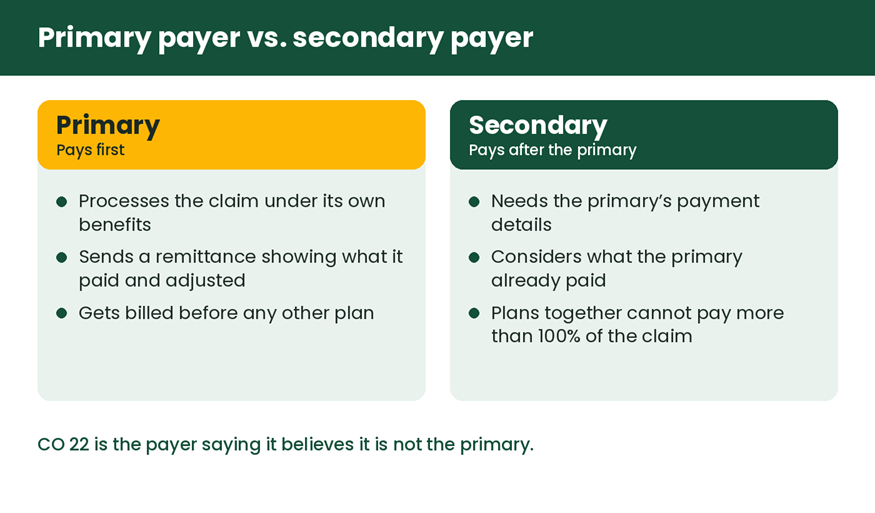
The CO 22 denial code means the payer believes another insurance plan should pay this claim first. It is a coordination of benefits problem: the claim reached the wrong payer, or reached the right payer in the wrong order. It is usually fixed by confirming which plan is primary and rebilling in the right sequence, and the patient cannot be billed for it. This guide shows how to read, fix and prevent it.
| Key takeaways CO 22 means the payer believes another plan should pay first under coordination of benefits.It is a billing-order problem, not a coding problem, and the patient should not be billed for it.Confirm which plan is primary, bill it first, then send the secondary payer the primary’s payment details.Complete coverage checks at every visit prevent most CO 22 denials. |
What the CO 22 Denial Code Means
CO 22 means the payer says the care may be covered by another payer. CARC (claim adjustment reason code) 22 reads “This care may be covered by another payer per coordination of benefits,” and the CO (contractual obligation) group code places the unpaid amount with the provider. Coordination of benefits (COB) decides which plan pays first.
CO 22 sits alongside the other common CO codes in our [LINK: CO denial codes list and meanings | /co-denial-codes-list/].
The wording comes from the X12 claim adjustment reason code list. For Medicare, the denial means Medicare’s records show another insurer should pay first. In that case Medicare tells the provider to bill the proper party.
Why CO 22 Happens
| Cause | Example | First check |
| Patient has two plans and the claim went to the wrong one first | Claim billed to the plan the patient mentioned last, not the primary | Confirm which plan is primary |
| Coverage changed and the file is outdated | Patient’s employer plan started or ended since the last visit | Ask the patient and re-verify eligibility |
| The payer’s COB record is wrong or old | Payer still lists another plan the patient no longer has | Have the patient update the payer’s record |
| Medicare Secondary Payer information missing | No questionnaire on file for a Medicare patient | Complete a Medicare Secondary Payer questionnaire |
| Dependent covered by two parents’ plans | Child listed on both parents’ plans | Apply the plans’ order rules, often the birthday rule |
For dependent children, many commercial plans decide order using the
[LINK: birthday rule in insurance | /birthday-rule-in-insurance/]. Always confirm with the plans, because rules differ.
How to Fix a CO 22 Step by Step
- Read the remit. Note the group code and any remark codes. Check whether the payer names the other insurer.
- Check the patient file. Review the insurance cards, intake form and the latest eligibility response for other coverage.
- Ask the patient. Confirm whether coverage changed, and who holds each policy.
- Confirm the order with the payers. Call both plans if needed and ask which one considers itself primary.
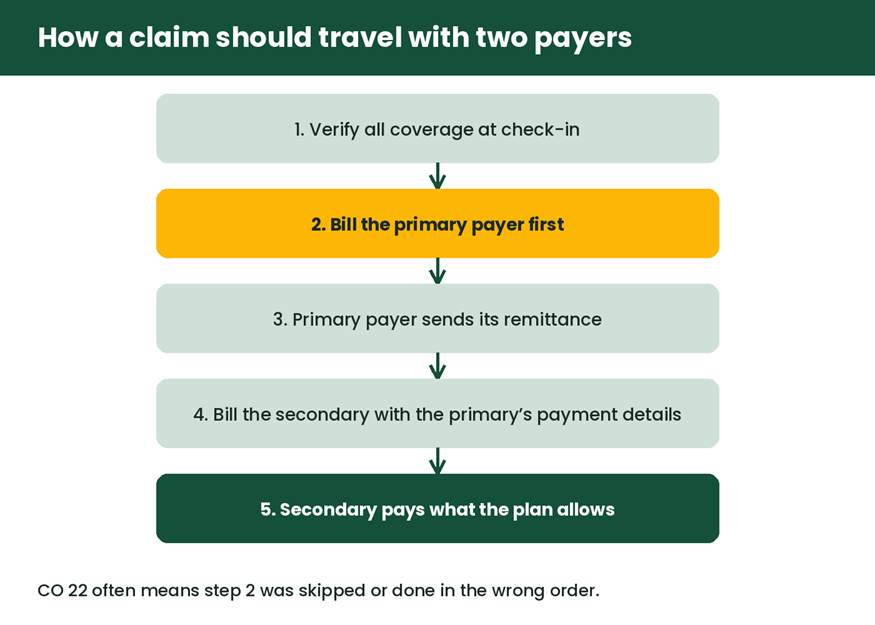
- Rebill in the right order. Bill the primary first. Then send the secondary a claim with the primary’s payment and adjustment details. Our guide on [LINK: how to bill secondary insurance | /how-to-bill-secondary-insurance/] covers the claim fields.
- Update records. If the payer’s record is wrong, the patient may need to correct it with the plan before you resubmit.
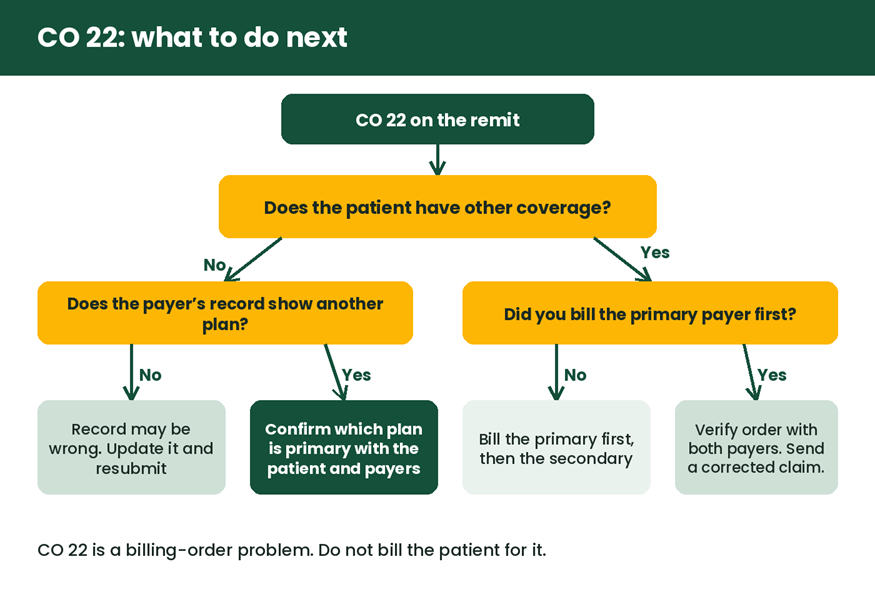
Diagram summary: check for other coverage, then check whether the primary was billed first, and update records, rebill or send a corrected claim.
Sample payer call wording: “I am calling about claim [number], date of service [date]. The remittance shows CO 22. Our records show your plan as primary. Can you confirm the coordination of benefits record on file and when it was last updated?”
What Medicare Providers Should Do
For a CO 22 from Medicare, First Coast Service Options’ CO 22 guidance suggests reviewing the file for a Medicare Secondary Payer (MSP) questionnaire, contacting the patient about insurance changes, and billing the primary payer first when Medicare is secondary. If your file shows Medicare was primary on the date of service, resubmit the claim, and if Medicare’s records are wrong, the patient needs to have them corrected.
The CMS coordination of benefits overview explains why: Medicare is not always the primary payer, and plans together cannot pay more than 100 percent of a claim.
Can You Bill the Patient for CO 22?
No. CO 22 is a routing problem, not patient responsibility. The CO group code leaves the unpaid amount with the provider, so do not send the patient a statement for the full charge. Once the plans pay in the right order, the patient owes only what the remittances report under PR group codes, such as deductible, copay or coinsurance.
CO 22 vs Similar Codes
CARC 23 reports the impact of prior payer adjudication and, per X12, is used only with group code OA.
See our guide to [LINK: OA 23 denial code | /oa-23-denial-code/] for how it appears. If the claim went to a plan that does not cover the patient at all, expect [LINK: CO 109 | /co-109-denial-code/] instead.
How to Prevent CO 22 Denials
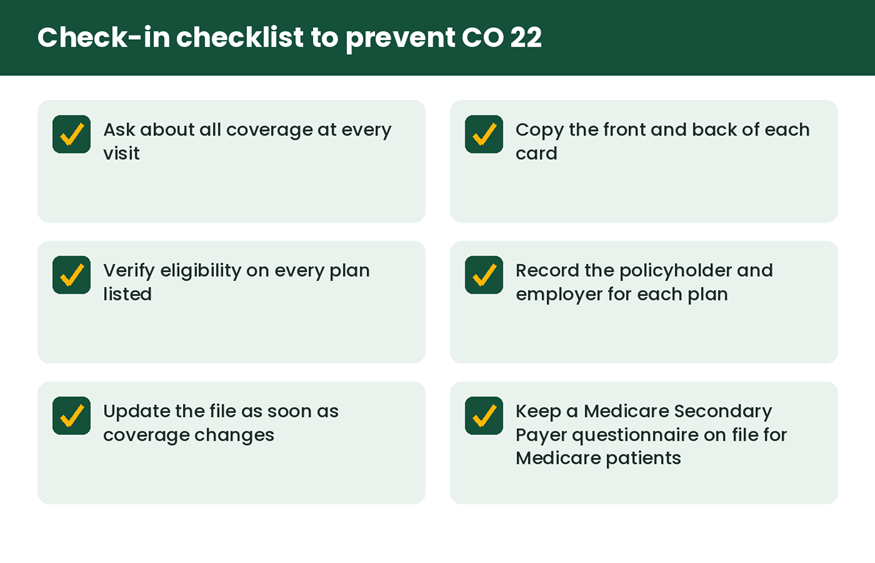
- Verify every plan at each visit. Our [LINK: insurance eligibility verification process | /insurance-eligibility-verification-process/] guide shows the steps.
- Ask about all coverage at every visit, not only new patients.
- Record the policyholder and employer for each plan.
- Update the file as soon as the patient reports a change.
- Work CO 22 denials in your A/R follow-up queue so secondary billing is not forgotten.
Get Help With Coordination of Benefits Denials
If CO 22 denials keep slowing your cash flow, our team can review a sample of your remittances and trace the pattern back to intake or billing order. Learn more about our denial management services.
Frequently Asked Questions
Should I appeal a CO 22 denial?
Usually not. CO 22 is a routing issue, so the fix is to confirm which plan is primary and rebill in the right order. Appeal only if you have proof the denying payer is primary and it still refused to process the claim. Include the coordination of benefits details and the patient’s coverage information.
Can I bill the patient for a CO 22 denial?
No. The CO group code leaves the balance with the provider. Do not send a statement for the full charge while coordination of benefits is unresolved. After the plans pay in order, bill the patient only for the deductible, copay or coinsurance amounts that the remittances assign under PR group codes.
What if the primary payer denies the claim too?
Keep the primary payer’s denial and remittance. Many secondary payers still need that information with the claim, and some process the claim once they see it. Requirements differ by payer, so check the secondary plan’s provider manual before resubmitting, and fix any error the primary identified.
Does CO 22 always mean Medicare is secondary?
No. For a Medicare CO 22, it means Medicare’s records show another insurer should pay first. Check the Medicare Secondary Payer questionnaire and eligibility. If your records show Medicare was primary, resubmit. If Medicare’s records are wrong, the patient has to contact the MSP contractor to correct them.
What is the difference between CO 22 and OA 23?
CO 22 says another payer may be responsible, so the payer did not process the claim as primary. CARC 23 reports the impact of prior payer adjudication, such as payments and adjustments, and X12 says to use it only with group code OA. One flags a routing problem. The other reports what already happened.
Sources: X12 Claim Adjustment Reason Code list, First Coast Service Options CO 22 guidance and the CMS coordination of benefits overview. This article is general education, not legal or payer-specific advice; your contracts and each payer’s provider manual govern how claims are processed.