
The CO 16 denial code means the payer could not process a claim because it lacks required information or contains a billing error. The provider owns the problem, and the fix is usually to correct the claim and send it again, not to appeal. This guide shows how to read the remark code, find the exact field, resubmit correctly and stop repeats. CO-16 is one of the common claim denial codes every billing team should know.
What the CO 16 Denial Code Means
CO 16 means “claim/service lacks information or has submission/billing error(s).” CO is the group code and shows the provider is financially responsible. 16 is the claim adjustment reason code (CARC). The payer must send at least one remittance advice remark code (RARC) with it, and that remark tells you what to fix.
CO-16 is not a clinical or coverage decision. It says the claim could not be adjudicated as submitted. Think of it as a wrapper: the payer flags a problem and the RARC identifies it. If an attachment or invoice is missing, payers use a different CARC (252) instead. For the full code families,
see [LINK: CARC vs RARC codes explained | /carc-vs-rarc-codes-explained/].
How to Read the Remark Code on a CO-16 Denial
Start with the RARC on the remittance advice, either the electronic ERA or a paper EOB. It points to the field that failed. The sample below uses fictional data.
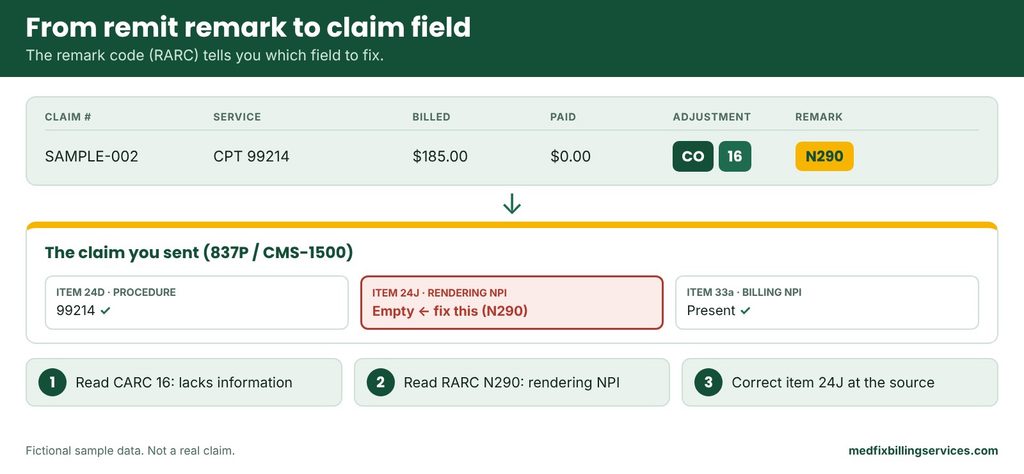
In short: the remark code names the field, so match it to the claim before you change anything. The table lists remarks that often appear with CO-16.
| Remark code | What it says | Check this |
| N290 | Rendering provider identifier missing, incomplete or invalid | Rendering NPI (item 24J) |
| N257 | Billing provider identifier missing, incomplete or invalid | Billing NPI (item 33a) |
| N264 / N265 | Ordering provider name or identifier missing, incomplete or invalid | Referring or ordering provider (items 17, 17b) |
| M51 | Procedure code missing, incomplete or invalid | CPT/HCPCS and modifiers (item 24D) |
| M81 | You are required to code to the highest level of specificity | ICD-10-CM codes (item 21) |
| N382 | Patient identifier missing, incomplete or invalid | Medicare MBI or member ID (item 1a) |
| MA120 | CLIA certification number missing, incomplete or invalid | CLIA number (item 23) |
| MA04 | Secondary payment cannot be considered without primary payer information | Primary payer name and payment details |
Wording varies by payer, so read the exact remark text.
Our guides to the [LINK: MA130 remark code | /ma130-remark-code/] and the [LINK: N290 remark code | /n290-remark-code/] go deeper.
Common Causes of CO-16 Denials
- Patient data: a name, date of birth or member ID that does not match the payer’s records.
- Provider data: a missing or invalid rendering, billing or referring NPI.
- Claim data: a wrong date of service, place of service, diagnosis pointer or modifier.
- Coordination of benefits: a secondary claim sent without the primary payer’s information.
- Setup changes: a new provider not added to the billing system, or a software change that dropped a field.
How to Fix a CO-16 Denial Step by Step
- Read the full remit line: group code, CARC, RARC, amount and claim number.
- Match the RARC to the claim field in the table above and confirm the error on the original claim.
- Correct the data in your practice management system, not only on the claim form, so the error does not repeat.
- Check the payer’s instruction. If the remark says the claim is unprocessable with no appeal rights (such as MA130), send a new claim. Otherwise send a corrected claim as the payer directs.
- For a corrected claim, use frequency code 7 and the original claim number: REF segment F8 in loop 2300 on an electronic 837P, or item 22 on a paper CMS-1500.
- Resubmit before the payer’s timely filing limit and put the date on your work queue.
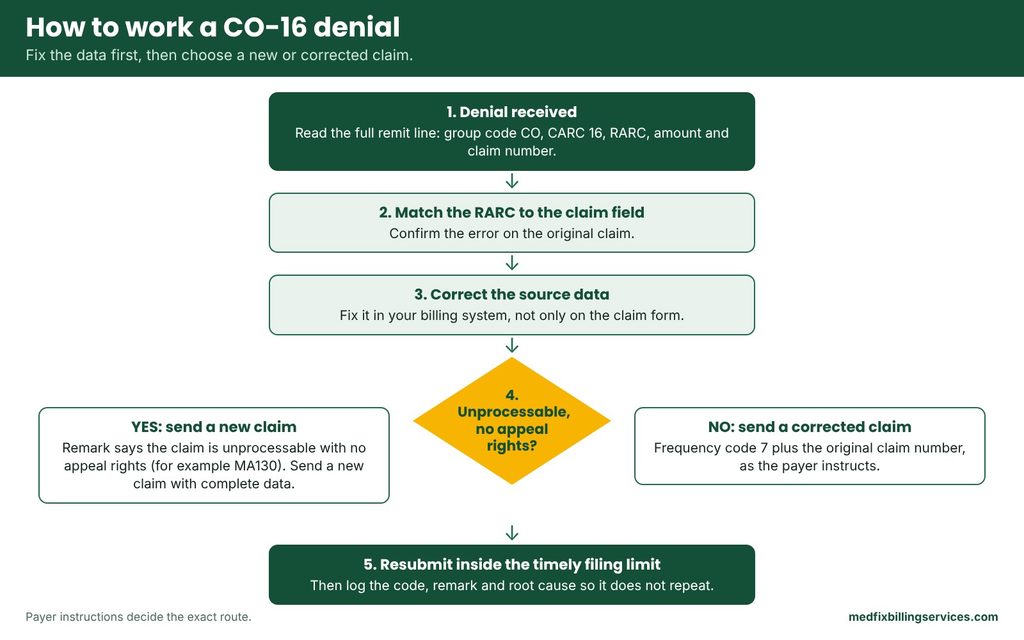
In short: fix the data, choose a new or corrected claim based on the remark, resubmit, then log the cause.
Example with fictional data
A sample claim for a $185.00 office visit (CPT 99214) came back CO-16 with N290. A new physician’s NPI had not been added to the billing system, so item 24J was blank. The biller added the NPI to the provider record, sent a corrected claim with frequency code 7, and asked the front office to add NPI setup to its new-provider checklist.
Can You Appeal a CO-16 Denial?
Usually no. CO-16 means the claim was missing information or had an error, so the payer expects a corrected claim, not an appeal. Medicare contractors treat unprocessable claims as not appealable, and an appeal can use up your timely filing window. Appeal only when the original claim was complete and correct and the payer applied the code in error. See [LINK: corrected claim vs appeal | /corrected-claim-vs-appeal/].
Can You Bill the Patient for a CO-16 Denial?
Generally no. CO means contractual obligation, so the provider absorbs the amount while the claim is denied. After the corrected claim is processed, the patient may owe a copay, deductible or coinsurance shown on the new remit under a PR group code. Check the payer contract for exceptions.
CO-16 vs Similar Denial Codes
| Code | What the payer is saying | Usual fix |
| CO-16 | Claim/service lacks information or has submission/billing error(s) | Correct the data and resubmit |
| CO-4 | Procedure code is inconsistent with the modifier used, or a required modifier is missing | Fix the modifier: [LINK: CO-4 denial code | /co-4-denial-code/] |
| CO-11 | Diagnosis is inconsistent with the procedure | Review coding and diagnosis pointers |
| CO-18 | Exact duplicate claim or service | Check claim status first: [LINK: CO-18 denial code | /co-18-denial-code/] |
| CO-50 | Service is not deemed a medical necessity by the payer | Clinical records and appeal: [LINK: CO-50 denial code | /co-50-denial-code/] |
| CO-109 | Claim is not covered by this payer; send it to the correct payer | Bill the correct payer |
How to Prevent CO-16 Denials
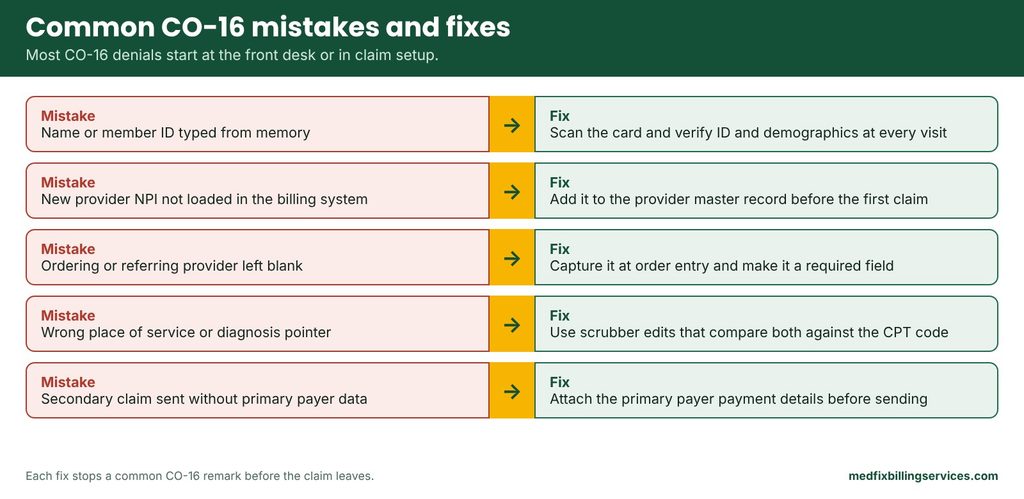
Most CO-16 denials are made before the claim is sent. The graphic shows the five mistakes that cause them and the fix for each.
- Keep a current provider master record with each NPI, taxonomy and enrollment status.
- Turn on claim scrubber edits for required fields and payer-specific rules.
- Track CO-16 by remark code every month to find the repeat cause. Clean claims start with solid medical billing workflows.
Get Help With Repeat CO-16 Denials
If the same CO-16 remarks keep returning, the cause is usually upstream. Medfix reviews denial patterns, fixes the data at the source and works resubmissions through our denial management service. You can also request a free billing audit to see where claims are leaking revenue.
Frequently Asked Questions
Does a CO-16 denial always need a corrected claim?
Not always. If the payer returned the claim as unprocessable, such as Medicare with remark MA130, you send a new claim. Other payers want a corrected claim with frequency code 7. Follow the instructions in the remark text and the payer’s provider manual, because the required format differs by payer.
How long do I have to fix a CO-16 denial?
The corrected claim must reach the payer before its timely filing limit. Medicare allows one calendar year from the date of service. Commercial payers set their own limits in the contract and provider manual, and corrected-claim windows differ, so check the limit the day the denial arrives.
What if my CO-16 denial has no remark code?
Look again at the full 835 or EOB, because the remark can appear at claim level, service-line level or in a policy reference segment. X12 requires at least one remark with this code. If you still cannot find one, call the payer’s provider line or ask your clearinghouse for the complete 835 detail.
Is CO-16 a rejection or a denial?
It depends on the payer’s process. A clearinghouse or payer front-end edit can reject a claim before adjudication, with no remittance. CO-16 appears on a remittance advice, so the payer processed the claim. Medicare calls this kind of claim unprocessable. Treat both as a correct-and-resubmit problem.
Sources and references: X12 claim adjustment reason and remark code lists (Washington Publishing Company), CMS Medicare Claims Processing Manual guidance on unprocessable claims, CMS-1500 and 837P claim instructions, and each payer’s provider manual. This article is general education and does not replace payer-specific or legal advice.