
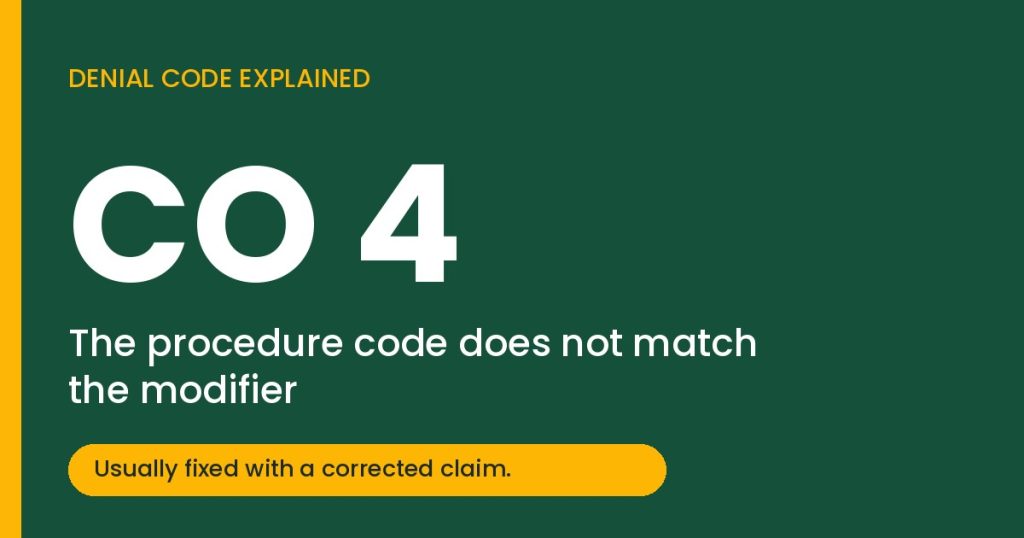
The CO 4 denial code means the payer found that the procedure code on a claim line does not fit the modifier reported with it. The modifier may be wrong, missing or not allowed for that code. It is a billing error on the provider’s side, usually fixed with a corrected claim rather than an appeal, and the patient cannot be billed for it. This guide explains the causes, the fix and how to prevent it.
| Key takeaways CO 4 means the procedure code and its modifier do not agree, and the CO group code makes the fix the provider’s job.The usual cause is a missing, wrong or invalid modifier, so correct the claim instead of arguing the payment.Medicare claims returned as unprocessable cannot be appealed and must be corrected and resubmitted.A modifier check before submission prevents most CO 4 denials. |
What the CO 4 Denial Code Means
CO 4 means the payer says the procedure code is inconsistent with the modifier used. A modifier is a two-character addition to a CPT or HCPCS code that changes its meaning, such as the side of the body or the professional component. The CO (contractual obligation) group code makes the error the provider’s responsibility.
CO 4 sits with the other common adjustment reasons in our [LINK: CO denial codes list and meanings | /co-denial-codes-list/].
The reason code itself is a CARC (claim adjustment reason code). The wording in the X12 claim adjustment reason code list is “The procedure code is inconsistent with the modifier used.” In day-to-day billing, CO 4 also appears when a required modifier is missing. Read the remark code beside it on the remittance, because that code usually points to the exact problem.
Why CO 4 Denials Happen
Nearly every CO 4 traces back to one of the patterns below. If a modifier is unfamiliar, our [LINK: guide to CPT modifiers | /cpt-modifiers-list/] explains each one.
| Cause | Example | Fix |
| Required modifier missing | Physical therapy code billed without GP, GO or GN where the payer requires it | Add the modifier the payer requires |
| Modifier not valid for the code | Modifier 50 on a code already described as bilateral | Remove it or use the correct modifier |
| Wrong side or component | RT or LT on a procedure with no side; 26 or TC on a code with no split | Match the modifier to the procedure |
| Payer-specific modifier rule | Modifier 25 required when an E/M shares a day with a procedure | Check the provider manual and edit list |
| Pair of codes that needs a distinct-service modifier | Two codes that bundle unless modifier 59 or an X modifier applies | Add it only if documentation supports it |
For the last pattern, the CMS NCCI edits page covers the Medicare procedure-to-procedure edits and links CMS guidance on modifiers 59, XE, XP, XS and XU. Some payers report these edits as
[LINK: CO 236 | /co-236-denial-code/] instead.
A CO 4 Example: Before and After the Fix
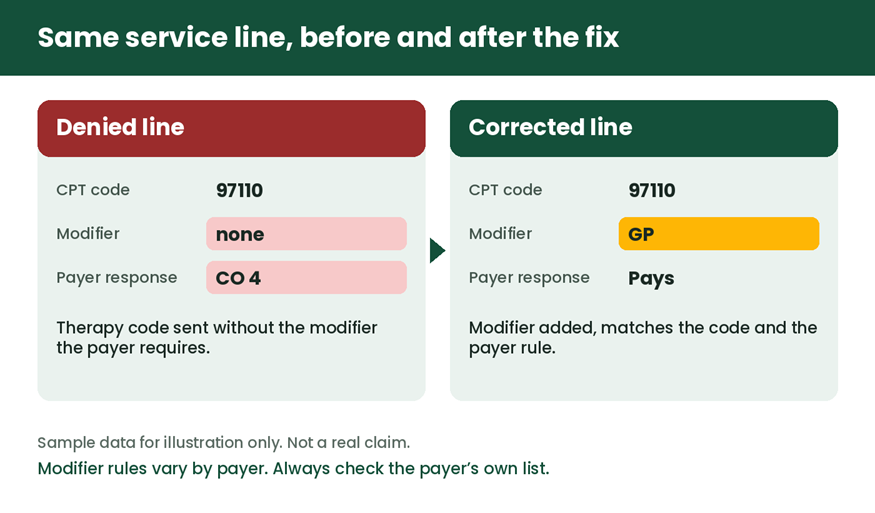
Here is a fictional case. A payer that requires the GP modifier on physical therapy codes returns CO 4 for a CPT 97110 line billed without it. The practice adds GP, sends the correction and the line pays.
How to Fix a CO 4 Denial Step by Step
- Read the remit line. Note the group code, the CARC and every remark code.
- Compare the claim with the documentation. Check the CPT code and modifier against the encounter note and charge entry.
- Check the payer’s modifier rules. Use the provider manual or edit list. For Medicare, start with the NCCI edits.
- Correct the source. Fix the charge line in your billing system, not only the claim file, so the error does not return.
- Resubmit the right way. Send a corrected claim under the payer’s rules, often with [LINK: claim frequency code 7 | /corrected-claim-frequency-code-7/], or a new claim if it was rejected as unprocessable.
- Log the cause. Record the code, modifier and payer so repeat errors show up.
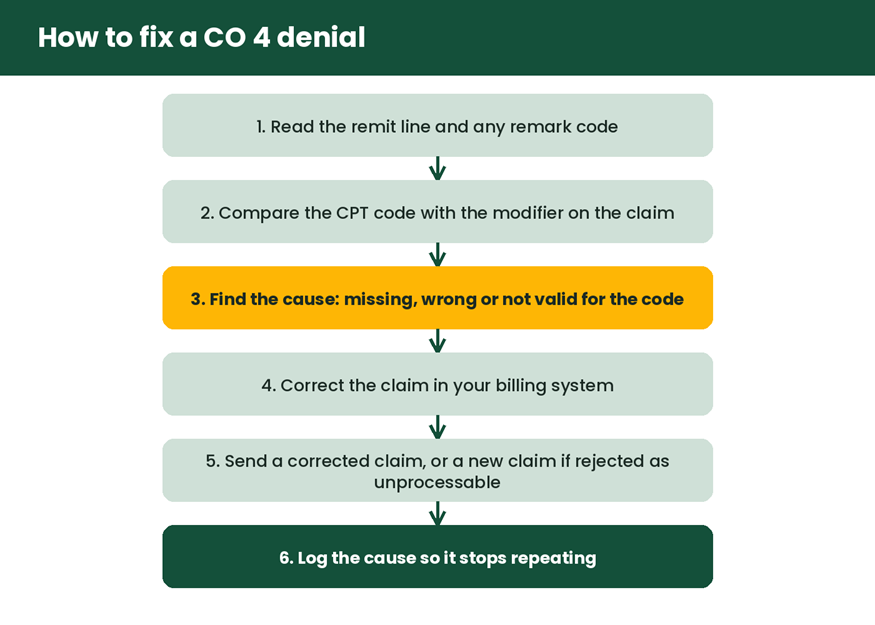
Diagram summary: read the remit, find the modifier problem, correct it at the source, resubmit and log the cause.
Sample correction note: “Claim [number], line [x]: modifier [GP] added to CPT [97110] per payer policy. Corrected claim submitted [date].”
Corrected Claim, New Claim or Appeal?
Fix the claim; do not appeal in most CO 4 cases. A modifier error is a billing mistake, so the usual remedy is a corrected claim, or a new claim if the payer rejected it as unprocessable. Appeal only when the modifier was right and the payer applied its edit wrongly, and attach documentation that supports the modifier.
For Medicare, unprocessable claims carry remark code [LINK: MA130 | /ma130-remark-code/]. First Coast Service Options explains that claims returned as unprocessable cannot be appealed, so correct the information and resubmit.
Filing limits apply to corrected claims too, and they vary by payer. Check the contract or provider manual, and work CO 4 lines as soon as they post.
Can You Bill the Patient for a CO 4 Denial?
No. CO means contractual obligation, so a CO 4 denial is the provider’s responsibility. Billing the patient for a claim denied over a modifier error is not appropriate under most payer contracts. Correct the claim instead. If it pays, any patient share will appear on the new remittance under PR group codes.
CO 4 vs Similar Denials
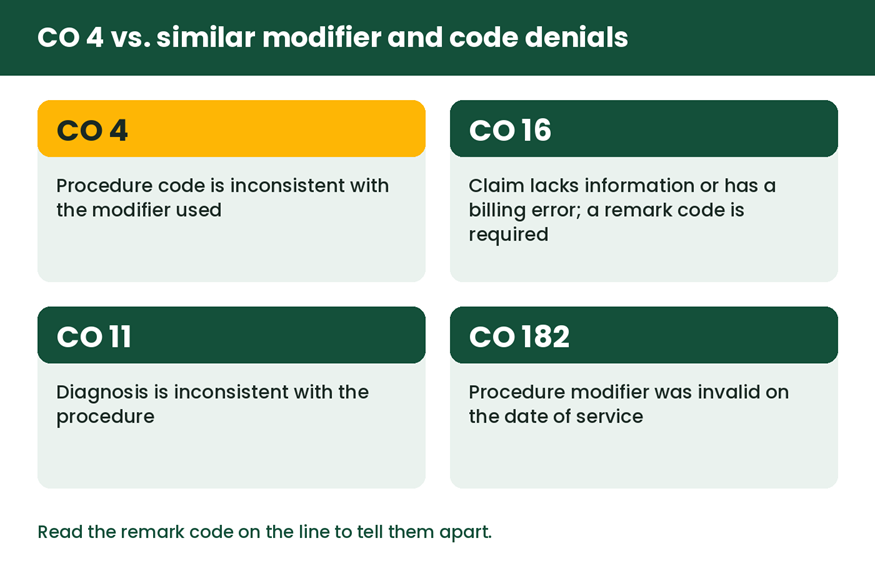
CO 4 is easy to confuse with other billing-error denials. [LINK: CO 16 | /co-16-denial-code/] means the claim lacks information or has an error and always comes with a remark code. [LINK: CO 11 | /co-11-denial-code/] says the diagnosis is inconsistent with the procedure. CO 182 says the procedure modifier was invalid on the date of service.
How to Prevent CO 4 Denials
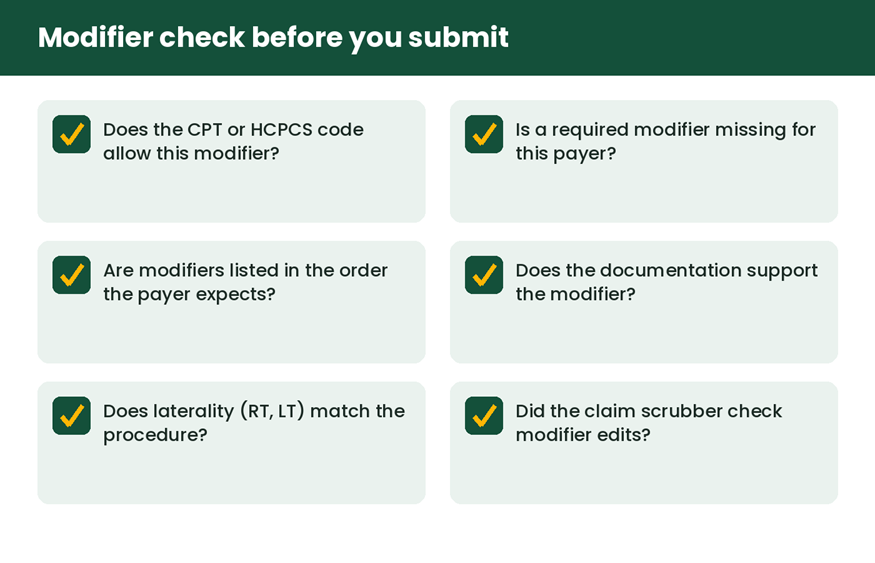
- Keep a payer-by-payer modifier rule sheet and update it when payers publish changes.
- Turn on claim scrubber edits for code-to-modifier checks and review which ones fire.
- Have coders confirm each modifier against the documentation before the claim goes out.
- Audit a small sample of claims every month. A regular medical coding review catches patterns early.
- Track CO 4 by CPT code, modifier and payer to find the repeat offenders.
Get Help With Modifier and Coding Denials
If CO 4 keeps returning on the same codes, our team can review a sample of your denials and trace the pattern back to coding or charge entry. Learn more about our denial management services.
Frequently Asked Questions
Is CO 4 always about a missing modifier?
No. X12 describes CO 4 as a procedure code inconsistent with the modifier used, which can mean a wrong modifier, an invalid combination or, commonly in practice, a required modifier that is missing. The remark code on the line and the payer’s modifier rules show which one applies.
Do I need to appeal a CO 4 denial?
Usually not. Correct the modifier and send a corrected claim, or a new claim if the payer rejected the original as unprocessable. Appeal only if the modifier was correct and supported by documentation, and the payer applied its edit in error. Include the documentation with the appeal.
How do I resubmit a claim denied with CO 4?
Correct the modifier on the affected line, then send a corrected claim under the payer’s rules, or a new claim if it was rejected as unprocessable. Many payers use claim frequency code 7 for replacement claims, but requirements differ, so check the provider manual and keep the correction note on the account.
Can the patient be billed for a CO 4 denial?
No. The CO group code places the balance with the provider. A denial caused by a modifier error is a billing problem, not patient responsibility. Correct and resubmit the claim, and bill the patient only for amounts the payer later reports with PR group codes, such as deductible or coinsurance.
What is the difference between CO 4 and CO 16?
CO 4 points to a conflict between the procedure code and its modifier. CO 16 is broader: the claim lacks information or has a billing error, and the payer must send at least one remark code explaining what to fix. Check the remark code on either denial before you correct the claim.
Sources: X12 Claim Adjustment Reason Code list, CMS NCCI edits page and First Coast Service Options appeals guidance. This article is general education, not legal or payer-specific advice; your contracts and each payer’s provider manual govern how claims are processed.