
The CO 50 denial code means the payer decided a service was not medically necessary under its coverage rules. The provider is responsible for the amount, and the fix depends on why. A coding or data error is corrected and resubmitted. A true necessity dispute is won with documentation and an appeal. This guide shows how to tell which one you have. CO-50 is one of the common claim denial codes every practice should be ready for.
What the CO 50 Denial Code Means
CO 50 reads “these are non-covered services because this is not deemed a ‘medical necessity’ by the payer.” CO is the group code, so the provider is financially responsible. 50 is the claim adjustment reason code (CARC). The payer found that the service did not meet its criteria for the diagnosis or documented condition.
Medicare bases this on national or local coverage determinations (NCDs and LCDs). Commercial payers use their own medical policies. Remark code N115 means the decision rested on an LCD, which lists the diagnoses that support the service.
Why CO-50 Denials Happen
- Diagnosis does not support the procedure under the payer’s policy.
- Missing or vague diagnosis: the claim carries a less specific code than the record supports, or leaves out the one that qualifies.
- Thin documentation: the note does not show why the service was needed.
- Frequency or limit exceeded: the service repeats more often than the policy allows.
- Wrong diagnosis pointer: the pointer links the procedure to an unrelated diagnosis.
Where the Medical Necessity Chain Breaks
A payer reads four things in order: the clinical note, the diagnosis code, the procedure billed and its own policy. If one link fails, the claim fails. The sample below uses fictional data.
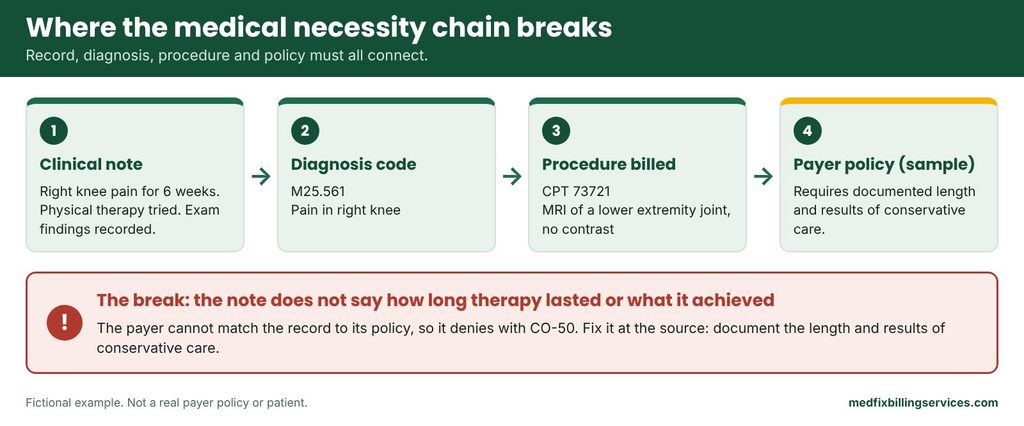
In short: if the note, diagnosis, procedure and policy do not line up, expect CO-50.
How to Fix a CO-50 Denial Step by Step
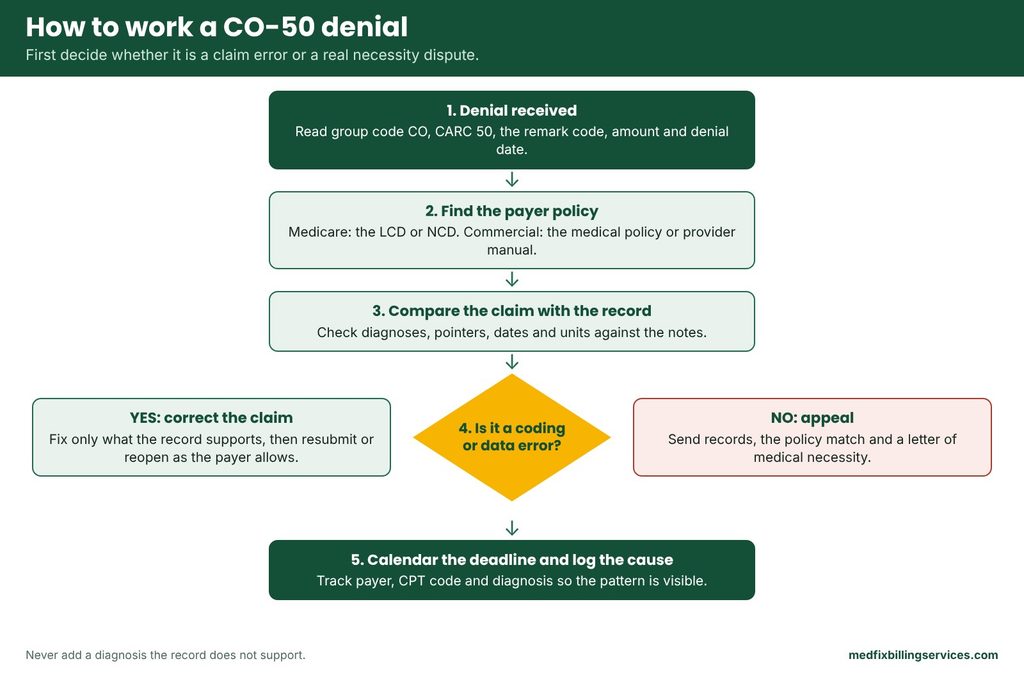
- Read the remit line: group code, CARC, remark code, amount and denial date.
- Find the policy. For Medicare, search the LCD or NCD in the Medicare Coverage Database. For commercial plans, use the payer’s medical policy or ask the provider line.
- Compare the claim with the record: diagnoses, pointers, dates and units.
- If a coding or data error exists and the record supports a covered diagnosis, correct the claim and resubmit, or use the payer’s reopening process. Never add a diagnosis the record does not document for that date of service.
- If the coding is right and the record supports the service, appeal with notes, results and a letter of medical necessity.
- Put the deadline on your work queue and log the cause
How to Appeal a CO-50 Denial
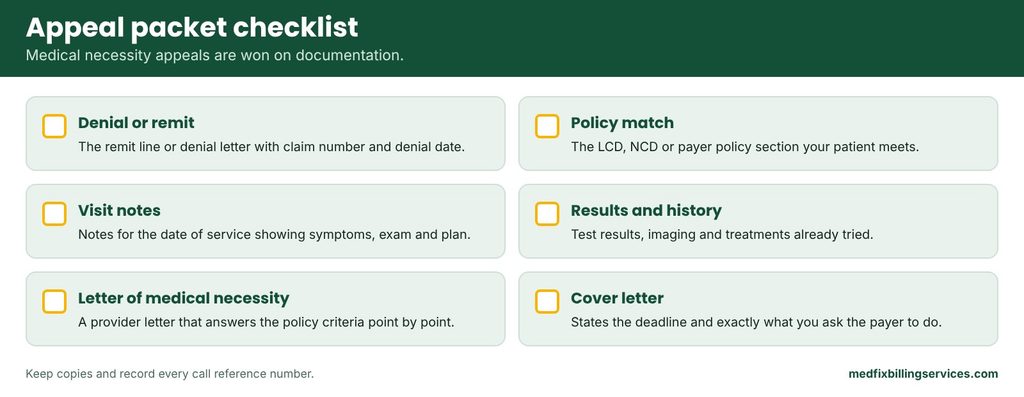
Appeal when the coding is accurate and the record shows the service was needed. Original Medicare allows 120 days from receipt of the initial determination for a redetermination. Commercial deadlines appear in the denial letter and provider manual, so read them first. The packet below covers what reviewers look for.
See also [LINK: how to appeal a denied insurance claim | /how-to-appeal-a-denied-insurance-claim/].
Sample letter of medical necessity wording (fictional data)
Re: Claim SAMPLE-0050, date of service 04/02/2026. I am writing to support the medical necessity of the MRI performed for this patient.
The patient had right knee pain for six weeks and completed four weeks of physical therapy without relief. Exam findings and therapy notes are enclosed. These facts meet the conservative-care criterion in your policy. Enclosures: visit notes, therapy records, exam findings, policy excerpt.
For help with the letter itself, see [LINK: how to write a medical necessity letter | /how-to-write-a-medical-necessity-letter/].
Medicare, ABNs and Who Pays
The group code shows liability: CO means the provider, PR means the patient. For Medicare, the notice and modifier on the claim decide it. An Advance Beneficiary Notice of Noncoverage (ABN, form CMS-R-131) must be signed before the service.
| Situation | Modifier | Liability if Medicare denies |
| Valid ABN signed before the service | GA | The patient may be billed |
| Denial expected, no ABN on file | GZ | The provider is liable |
| Service Medicare never covers (statutory exclusion) | GY | The patient is liable, no ABN needed |
Do not use GA routinely. Use it only when an ABN is on file and a denial is likely.
CO-50 vs Similar Denial Codes
| Code | What the payer is saying | Usual fix |
| CO-50 | Not deemed a medical necessity by the payer | Check policy, then correct or appeal |
| CO-11 | Diagnosis is inconsistent with the procedure | Review coding and pointers |
| CO-197 | Precertification or authorization absent | Find the approval: [LINK: CO-197 denial code | /co-197-denial-code/] |
| CO-16 | Claim lacks information or has a billing error | Correct the data: [LINK: CO-16 denial code | /co-16-denial-code/] |
How to Prevent CO-50 Denials
- Check the coverage policy before scheduling costly or frequently repeated services.
- Document why the service was needed and link every procedure to a diagnosis in the record.
- Code to the highest specificity the record supports. Our medical coding team builds this review into every claim.
- Add scrubber edits for LCD diagnosis rules and frequency limits.
- Review CO-50 by payer and CPT code each month. See [LINK: medical necessity documentation | /medical-necessity-documentation/].
Get Help With Medical Necessity Denials
If CO-50 keeps returning, the gap is usually in documentation or diagnosis coding. Medfix reviews denial patterns, corrects coding at the source and works appeals through our denial management service. You can also request a free billing audit to see which services are being denied.
Frequently Asked Questions
Can I bill the patient for a CO-50 denial?
Generally no. CO means the provider is responsible, so the patient cannot be billed unless the payer contract or a valid Medicare ABN says otherwise. Check the group code on the remit. If it shows PR, the amount belongs to the patient.
How is CO-50 different from CO-197?
CO-197 says a required authorization was absent. CO-50 says the payer judged the service not medically necessary. The fixes differ: CO-197 needs the approval or a retro request, while CO-50 needs coding review and clinical documentation. See [LINK: CO-197 denial code | /co-197-denial-code/].
How long do I have to appeal a CO-50 denial?
Original Medicare allows 120 days from receipt of the initial determination for a redetermination. Commercial payers set their own limits, usually shown in the denial letter and provider manual. Check the deadline the day the denial arrives and put it on your work queue.
Can I fix a CO-50 denial by changing the diagnosis code?
Only if the record already documents that diagnosis for the date of service and the original coding was wrong. Never add or change a diagnosis only to meet a coverage list. The claim must match the medical record, so query the provider when the link is unclear.
What does remark code N115 mean?
N115 means the decision was based on a Local Coverage Determination. Look up the LCD in the Medicare Coverage Database to see which diagnoses support the service, then compare them with your claim and the record before you correct or appeal.
Sources and references: X12 claim adjustment reason and remark code lists (Washington Publishing Company), CMS and Medicare contractor guidance on local coverage determinations, ABNs and appeals, and each payer’s medical policy and provider manual. This article is general education and does not replace payer-specific or legal advice.