
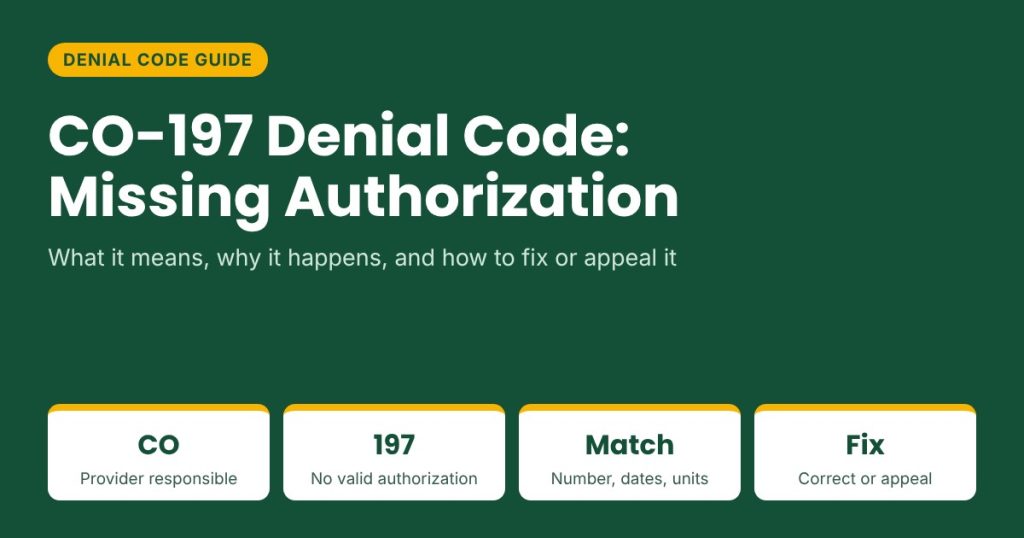
The CO 197 denial code means the payer found no valid precertification, authorization or notification for a service it requires one for. The provider is responsible for the amount, and the service has usually already been performed. Fix it by finding the approval and correcting the claim, requesting review, or appealing with proof. This guide covers all three. CO-197 is one of the common claim denial codes that cost practices the most revenue.
What the CO 197 Denial Code Means
CO 197 reads “precertification/authorization/notification/pre-treatment absent.” CO is the group code, so the provider is financially responsible. 197 is the claim adjustment reason code (CARC). It means the payer has no approval on file that matches the service, either because none was obtained or because the approval does not match the claim.
A related code, CARC 198, means an approval exists but was exceeded. The remark code (RARC) tells you more:
| Remark code | What it says | What it suggests |
| N210 | You may appeal this decision | The payer allows an appeal |
| M62 | Treatment authorization code missing, incomplete or invalid | Check the number on the claim |
| N54 | Claim information is inconsistent with pre-certified or authorized services | Compare CPT, units, dates and provider |
Why CO-197 Denials Happen
- No request: nobody checked whether the payer required an approval for this plan and CPT code.
- Late request: the approval was requested after the service date.
- Missing number: the approval exists but the number was not on the claim (item 23 on paper, loop 2300 REF segment with qualifier G1 electronically).
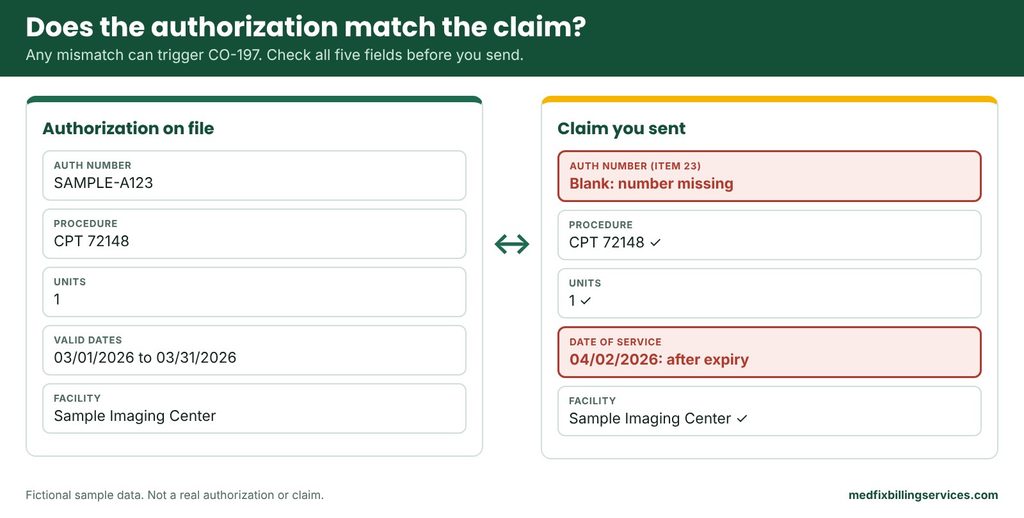
- Mismatch: the approval does not match the claim on CPT code, units, dates, facility or rendering provider.
- Expired or changed: the approval lapsed, or the patient’s plan or payer changed before the visit.
Check Whether the Authorization Matches the Claim
Before you appeal, compare the approval with the claim field by field. Many CO-197 denials come from a mismatch, not a missing approval. The sample below uses fictional data.
How to Fix a CO-197 Denial Step by Step
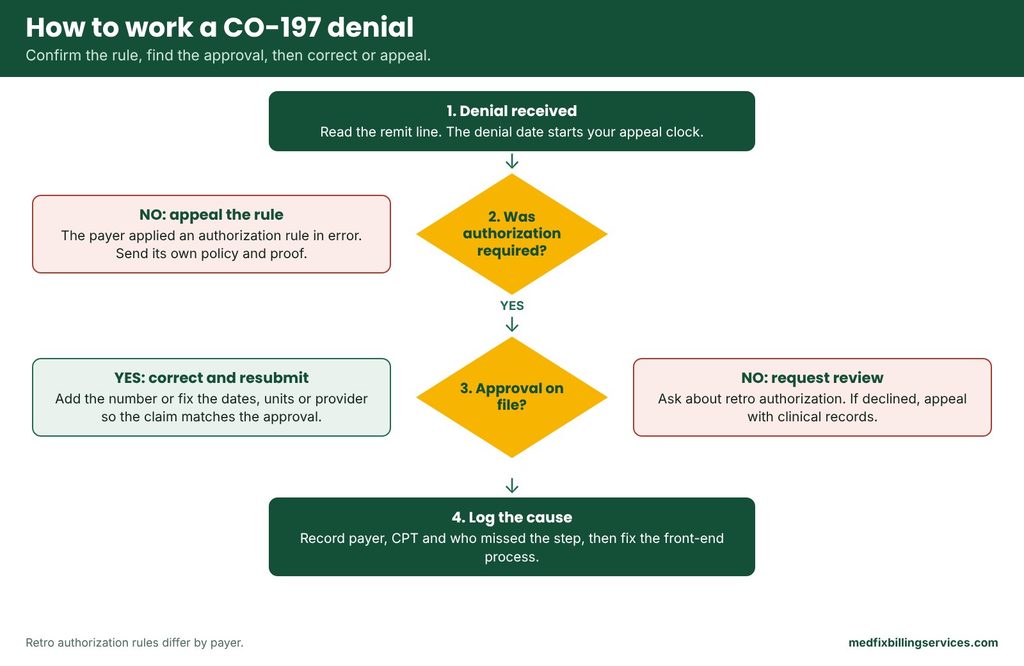
- Read the remit line and note the denial date. Your appeal clock starts there.
- Confirm that the payer required authorization for this plan, CPT code and date of service, using its portal or provider manual.
- Search for an existing approval. If it exists and matches, correct the claim with the number and resubmit.
- If the approval exists but details differ, ask the payer to update it or confirm the correction, then resubmit.
- If none exists, ask the payer whether it accepts retroactive authorization and within what window. Many limit it to emergencies or documented payer error.
- If the payer declines, appeal with proof. Log the cause so the front end can fix it.
How to Appeal a CO-197 Denial
Appeal when you hold proof of approval, the payer made an error, or the service was urgent and documented. Deadlines vary. Original Medicare allows 120 days from receipt of the initial determination for a redetermination, and commercial payers set their own limits in the contract. Put the date on your work queue. For the process, see [LINK: how to appeal a denied insurance claim | /how-to-appeal-a-denied-insurance-claim/].
- The approval letter or confirmation, with number, dates and units.
- Proof of eligibility on the date of service.
- Clinical notes showing urgency, if the service was emergent.
- Call references or portal screenshots that show a payer error.
| Sample appeal wording (fictional data) Re: Claim SAMPLE-0197, date of service 04/02/2026. We are appealing the CO-197 denial dated 04/20/2026. Authorization SAMPLE-A123 was obtained before the service and is attached. The number was omitted from the original claim by clerical error. We ask you to reprocess the claim with the authorization applied. Enclosures: approval letter, corrected claim, eligibility verification. |
For a fuller template, see [LINK: medical claim appeal letter template | /medical-claim-appeal-letter-template/].
Can You Bill the Patient for a CO-197 Denial?
Generally no. CO means contractual obligation, so the provider absorbs the amount unless the payer contract says otherwise. Check the group code on the remit before you send a balance to the patient.
CO-197 vs Similar Denial Codes
| Code | What the payer is saying | Usual fix |
| CO-197 | Precertification, authorization or notification absent | Find the approval, correct, request review or appeal |
| CO-198 | Precertification or authorization exceeded | Request more units or days, then appeal |
| CO-50 | Service is not deemed a medical necessity by the payer | Clinical records: [LINK: CO-50 denial code | /co-50-denial-code/] |
| CO-16 | Claim lacks information or has a billing error | Correct the data: [LINK: CO-16 denial code | /co-16-denial-code/] |
How to Prevent CO-197 Denials
Prevention is cheaper than appeal. Each checkpoint below has one owner and one proof of completion.
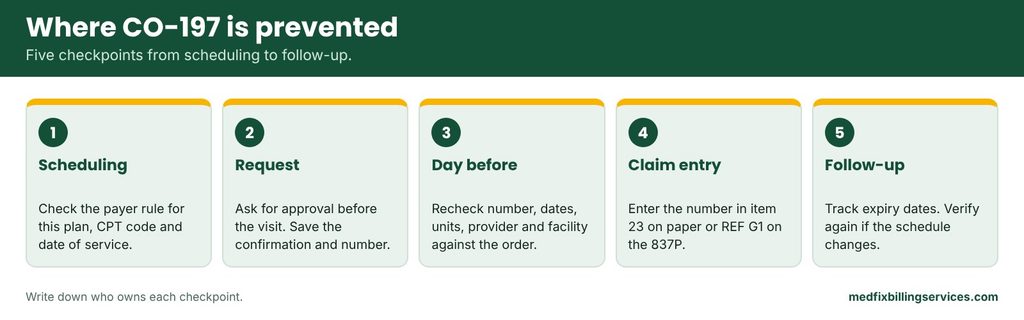
- Keep one authorization log with number, CPT code, units, dates, provider, facility and expiry date.
- Review the payer’s authorization list each quarter, because requirements change. See [LINK: prior authorization process | /prior-authorization-process/].
- Match every claim to its approval before release. Strong medical billing workflows build this check into claim entry.
Get Help With Authorization Denials
If CO-197 keeps appearing in your A/R, the cause is usually upstream. Medfix tracks authorizations, corrects claims and works appeals through our denial management service. You can also request a free billing audit to see where authorization gaps cost you revenue.
Frequently Asked Questions
Does CO-197 mean the service is not covered?
No. CO-197 says the required authorization, precertification or notification was absent or did not match. Coverage is a separate question. A covered service can still be denied for missing approval, and a medical necessity denial uses a different code, CO-50.
Can I get retroactive authorization after a CO-197 denial?
Sometimes. Many payers limit retroactive authorization to emergencies or documented payer or system errors, and the window is short. Call the payer as soon as the denial arrives, ask what it accepts, and keep the reference number. If it declines, appeal with clinical records.
Why did I get CO-197 when I had an authorization?
The approval probably did not match the claim. Compare the number, CPT code, units, dates, facility and rendering provider. Also confirm the number was on the claim, in item 23 on paper or in loop 2300 REF with qualifier G1 electronically. An expired approval gives the same denial.
How long do I have to appeal a CO-197 denial?
It depends on the payer. Original Medicare allows 120 days from receipt of the initial determination for a redetermination. Commercial payers set their own limits in the contract and provider manual. Check the deadline on the remit the day the denial arrives.
Does Original Medicare require prior authorization?
Only for a limited list of items and services. Medicare Advantage and commercial plans usually require it more widely. Check each payer’s current list before you schedule, because lists change.
Sources and references: X12 claim adjustment reason and remark code lists (Washington Publishing Company), CMS and Medicare contractor guidance on claim submission and appeals, CMS-1500 and 837P claim instructions, and each payer’s provider manual. This article is general education and does not replace payer-specific or legal advice.