

The CO 96 denial code means the payer treated a charge as non-covered and will not pay it. Sometimes the service really is excluded from the plan. Other times a claim, coding or payer error caused the denial. The group code and the remark code on the remittance show which one you are facing, and who is liable. This guide shows how to read them and choose the right response.
| Key takeaways CO 96 means the payer treated the charge as non-covered, and a remark code explaining why must come with it.The group code decides liability: CO leaves the balance with the provider, PR can leave it with the patient.Correct claim, coding or payer errors, appeal only when the service should be covered, and write off true exclusions.For Medicare, a valid ABN and the right G modifier change who pays. |
What the CO 96 Denial Code Means
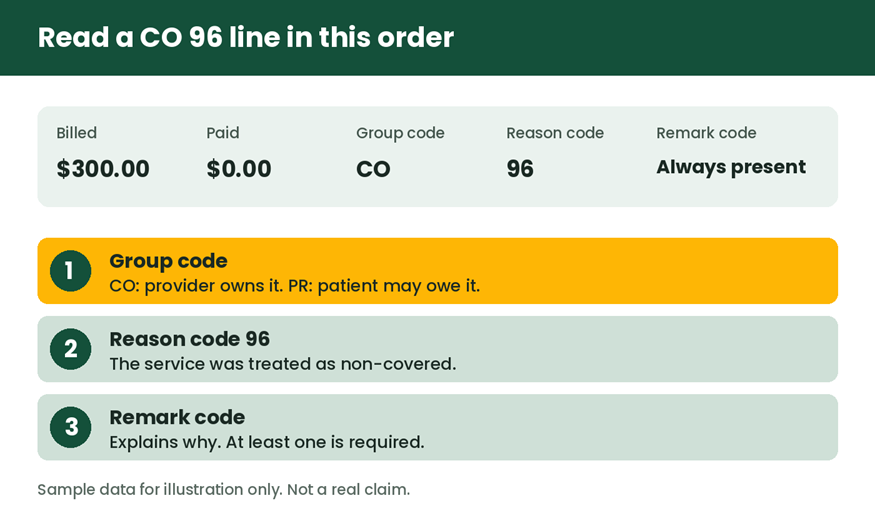
CO 96 means the payer treated the service as a non-covered charge. CARC (claim adjustment reason code) 96 is “Non-covered charge(s),” and the CO (contractual obligation) group code places the unpaid amount with the provider. The payer must also send at least one remark code that explains why.
CO 96 is one of the broader codes in our [LINK: CO denial codes list and meanings | /co-denial-codes-list/].
The X12 claim adjustment reason code list says at least one remark code must accompany CARC 96. A remark code (RARC) is the second code on the line that gives the specific reason. Always read the group code first, then the reason code, then the remark code.
Common Reasons Behind a CO 96
| Cause | Example | First check |
| Service excluded from the plan | A cosmetic or other excluded service billed to a plan that does not cover it | Read the plan’s benefit documents |
| Coverage policy not met | Diagnosis on the claim does not meet the payer’s policy for that service | Check diagnosis linkage against the policy |
| Frequency or visit limit reached | More visits or units than the plan allows in the period | Check the benefit limits and prior usage |
| No valid advance notice | Medicare service likely to be denied, billed without a signed ABN | Check the notice and the modifier used |
| Wrong payer or inactive coverage | Claim sent to a plan that does not cover the patient or date of service | Re-verify eligibility and payer |
Medicare: ABNs and G Modifiers
For Original Medicare, the ABN (Advance Beneficiary Notice of Noncoverage, form CMS-R-131) is the written notice a provider gives before a service Medicare is expected to deny. The CMS page on the fee-for-service ABN explains who issues it and when. The G modifier on the claim tells Medicare which notice situation applies.
| Modifier | What it signals | Liability if denied |
| GA | A required ABN was issued and is on file; claim is submitted as covered and Medicare decides | Depends on the decision and a valid ABN |
| GX | Voluntary notice for a service Medicare never covers | Patient |
| GY | Service is statutorily excluded or not a Medicare benefit; no ABN needed | Patient |
| GZ | Service expected to be denied as not reasonable and necessary, and no ABN was issued | Provider |
These definitions follow First Coast Service Options’ beneficiary notices guidance, which also warns that GA should not be used routinely. Check your own MAC’s guidance, because processing details can differ.
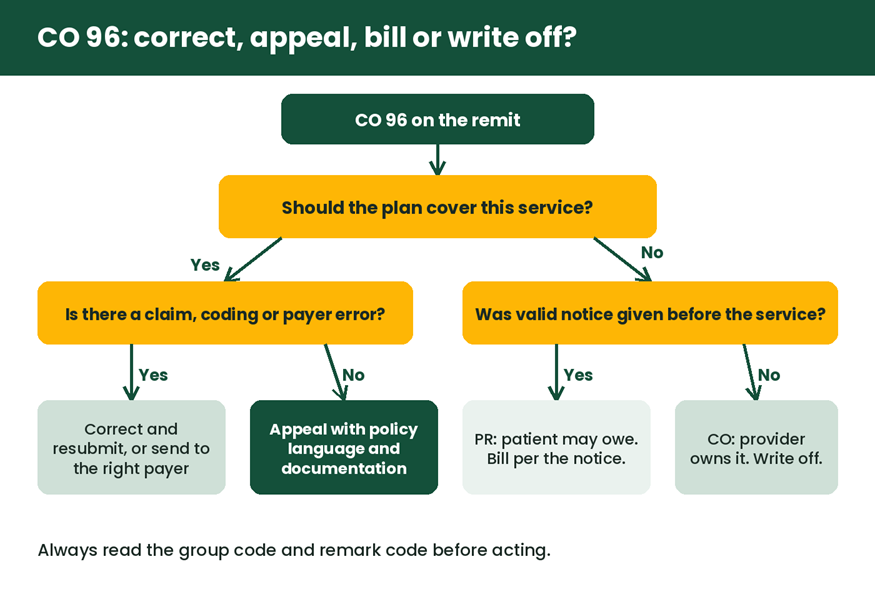
Diagram summary: if the plan should cover the service, fix any error or appeal; if not, valid advance notice decides whether the patient or the provider owns the balance.
Sample appeal wording: “We request reconsideration of claim [number], date of service [date]. The service is covered under [plan section or policy] because [clinical reason]. The patient’s diagnosis [code] meets the stated criteria. Supporting documentation is enclosed.”
Can You Bill the Patient for CO 96?
Not under the CO group code. CO places the unpaid balance with the provider. A patient can owe a non-covered charge only when the payer reports it under a PR group code, or when valid advance written notice supports patient liability under the payer’s rules, as with a signed Medicare ABN. Check the group code and the notice before you send a statement.
CO 96 vs Similar Denials
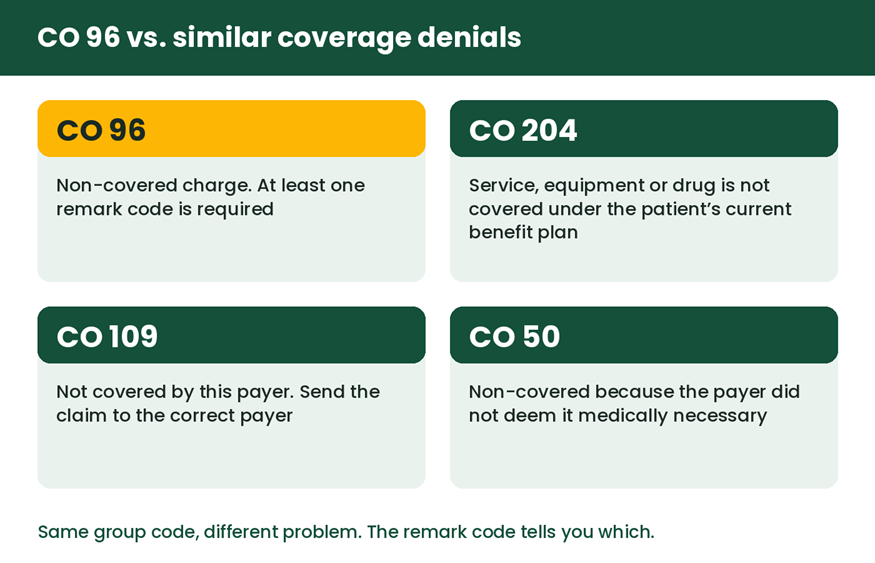
Several denials involve coverage. A medical necessity denial is covered in our guide to the CO 50 denial code. A service the plan does not cover at all can come back as [LINK: CO 204 | /co-204-denial-code/].
If the claim went to the wrong payer, expect [LINK: CO 109 | /co-109-denial-code/]. When the same reason is assigned to the patient, you will see [LINK: PR 96 | /pr-96-denial-code/] instead.
How to Prevent CO 96 Denials
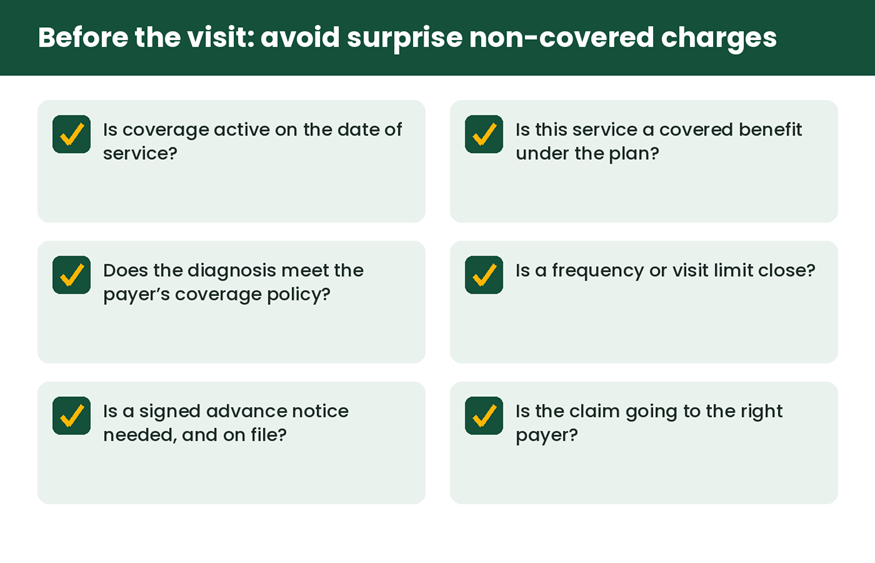
- Verify coverage and benefits before every visit. Our [LINK: insurance eligibility verification process | /insurance-eligibility-verification-process/] guide shows the steps.
- Check payer coverage policies for services you know are often excluded or limited.
- Get the right advance notice, such as a signed ABN for Medicare, before the service, and keep it on file.
- Keep a payer-by-payer list of common exclusions and frequency limits.
- Track CO 96 by payer and CPT code to find the repeat offenders.
Get Help With Coverage Denials
If CO 96 denials keep returning, our team can review a sample of your remittances and show whether the cause is eligibility, coding or missing notice. Learn more about our denial management services.
Frequently Asked Questions
Can I appeal a CO 96 denial?
Sometimes. If the service should be covered under the plan or policy, appeal with the benefit language, clinical documentation and a clear letter. If it is a true exclusion or a frequency limit, an appeal rarely succeeds. Read the remark code first, because it tells you which situation you are in.
Does CO 96 always come with a remark code?
Yes. X12 requires at least one remark code with CARC 96, so a CO 96 without one is incomplete. Call the payer and ask for the remark code or a corrected remittance, so you know whether to correct the claim, appeal or write off the charge.
What is the difference between CO 96 and PR 96?
Both use the same reason, non-covered charges. The group code decides who owns the balance. CO places it with the provider. PR places it with the patient, often because the plan does not cover the service or notice was given in advance. Read the group code before billing anyone.
What is an ABN and does it change a CO 96?
An ABN is a signed notice Original Medicare providers give before a service Medicare is expected to deny. A valid ABN can support patient liability. Without one, a Medicare denial for a service not reasonable and necessary generally leaves the provider liable, as the GZ modifier guidance describes.
How long do I have to appeal a CO 96?
Appeal deadlines are set by each payer and plan, and they differ. Look at the remittance and the provider manual as soon as the denial posts. Medicare appeals follow their own rules, so check the MAC’s guidance for Medicare claims and do not wait.
Sources: X12 Claim Adjustment Reason Code list, CMS fee-for-service ABN page and First Coast Service Options beneficiary notices guidance. This article is general education, not legal or payer-specific advice; your contracts and each payer’s provider manual govern how claims are processed.