
CO 11 means the payer decided the diagnosis linked to a claim line does not support the procedure on that line. Most of the time the cause is a coding or claim-entry error, such as a wrong diagnosis pointer or a vague code, and the fix is a corrected claim. Sometimes the claim is right and the payer’s edit is wrong, which calls for an appeal. This guide explains how payers run the check, the common causes, how to choose the right fix and how to prevent CO 11 before claims go out.
| Key takeaways CO 11 is reason code 11: “The diagnosis is inconsistent with the procedure.” It is applied line by line.Start with the medical record. It decides whether the claim, the payer or the documentation is the problem.Wrong pointers, unspecified codes and outdated templates cause most CO 11 denials.Never change a diagnosis just to match a payer list. Code only what the record supports. |
What the CO 11 Denial Code Means
CO 11 is a claim adjustment reason code (CARC), one of the standard codes payers use on the remittance to explain an adjustment. Reason code 11 reads “The diagnosis is inconsistent with the procedure.” The CO (contractual obligation) group code puts the denied amount on the provider, so it is not billed to the patient.
The check runs per service line. One line can deny with CO 11 while the rest of the claim pays. CO 11 sits with the coding-related codes in our [LINK: CO denial codes list and meanings | /co-denial-codes-list/], and it is usually one of the easier ones to fix, because the answer is almost always in the visit note.
How Payers Check the Diagnosis Against the Procedure
Payer systems compare each procedure code with the diagnosis codes it points to. On the CMS-1500, item 21 holds up to 12 diagnosis codes, labeled A through L, and item 24E on each service line points back to them. The CGS Medicare CMS-1500 form tutorial asks for one primary diagnosis reference per line for Medicare, and many other payers accept up to four pointers per line.
The payer then applies its own logic to that pairing. Commercial plans use their medical and payment policies. Medicare contractors publish covered diagnosis lists in local coverage determination (LCD) billing and coding articles, which you can find in the Medicare Coverage Database. If you need a refresher on how those policies work, see [LINK: LCD vs NCD | /lcd-vs-ncd/].
Common Causes of CO 11 Denials
Most CO 11 denials come from how the claim was built, not from the care itself. The usual causes are:
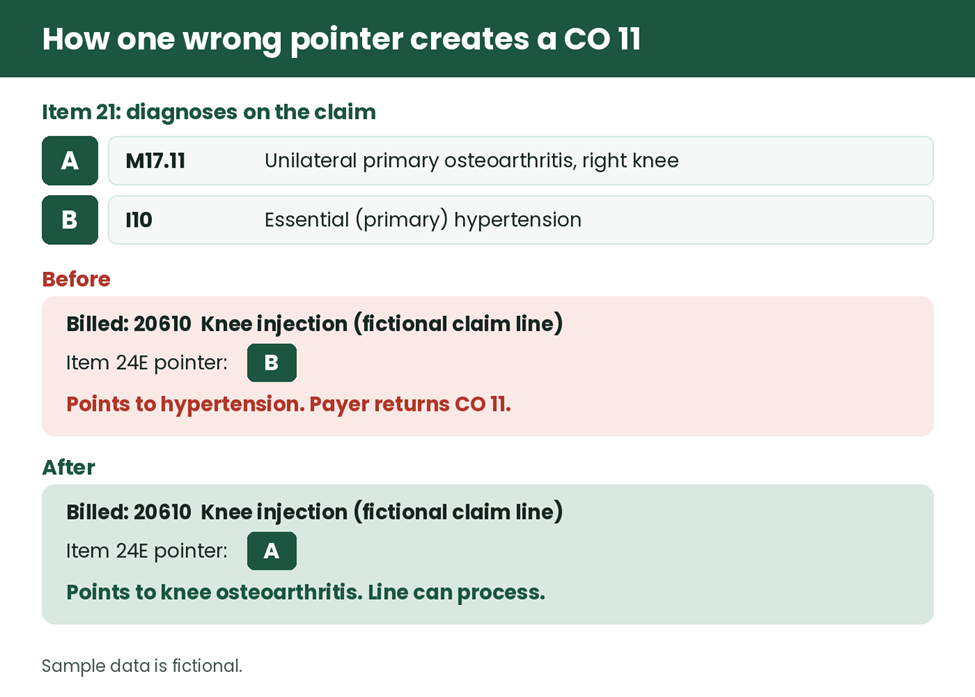
- The wrong diagnosis pointer. The right codes are on the claim, but the line points to a chronic condition, such as hypertension, instead of the reason for the procedure.
- A code that is too vague. An unspecified or symptom code where the note supports a specific diagnosis. Our guide to [LINK: ICD-10 unspecified codes | /icd-10-unspecified-codes/] explains when they are and are not appropriate.
- A typo or transposed code. One wrong character turns a knee diagnosis into an unrelated condition.
- A screening code on a diagnostic service, or the reverse. The visit reason and the code type do not match the service billed.
- Outdated templates or charge mappings. A diagnosis built into an order set or charge rule no longer fits the services it is attached to, often after the annual code update.
- Payer policy limits. The diagnosis is correct, but the payer’s policy does not list it for that procedure.
CO 11 vs Similar Denial Codes
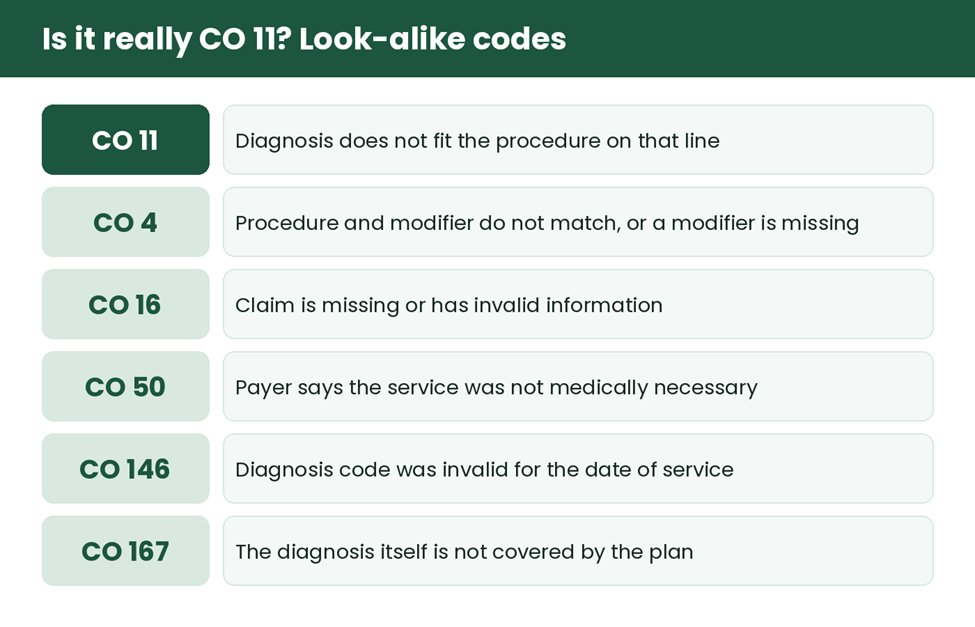
Several codes look like CO 11 at first glance. A modifier problem is a CO 4 modifier denial, and a payer that questions whether the service was needed at all is sending a CO 50 medical necessity denial. Reading the code correctly saves a wasted correction.
| Code | What the payer is saying | First move |
| CO 11 | The diagnosis does not fit the procedure on this line | Compare the claim with the visit note |
| CO 4 | The procedure and modifier do not match, or a modifier is missing | Review modifier rules for the code |
| CO 16 | The claim lacks information needed to process it | Add the missing data shown in the remark code |
| CO 50 | The service is not considered medically necessary | Review coverage policy and documentation |
| CO 146 | The diagnosis code was invalid for the date of service | Recode with a code valid on that date |
| CO 167 | The diagnosis itself is not covered | Check the plan’s coverage for that condition |
If the remark code points to missing or invalid claim data rather than the pairing, treat it as a CO 16 denial for missing information. And when the plan says the condition itself is excluded, our page on the [LINK: CO 167 denial code | /co-167-denial-code/] covers that fix.
How to Fix a CO 11 Denial Step by Step
Do not resubmit the same claim, and do not swap in a different diagnosis until you have read the note.
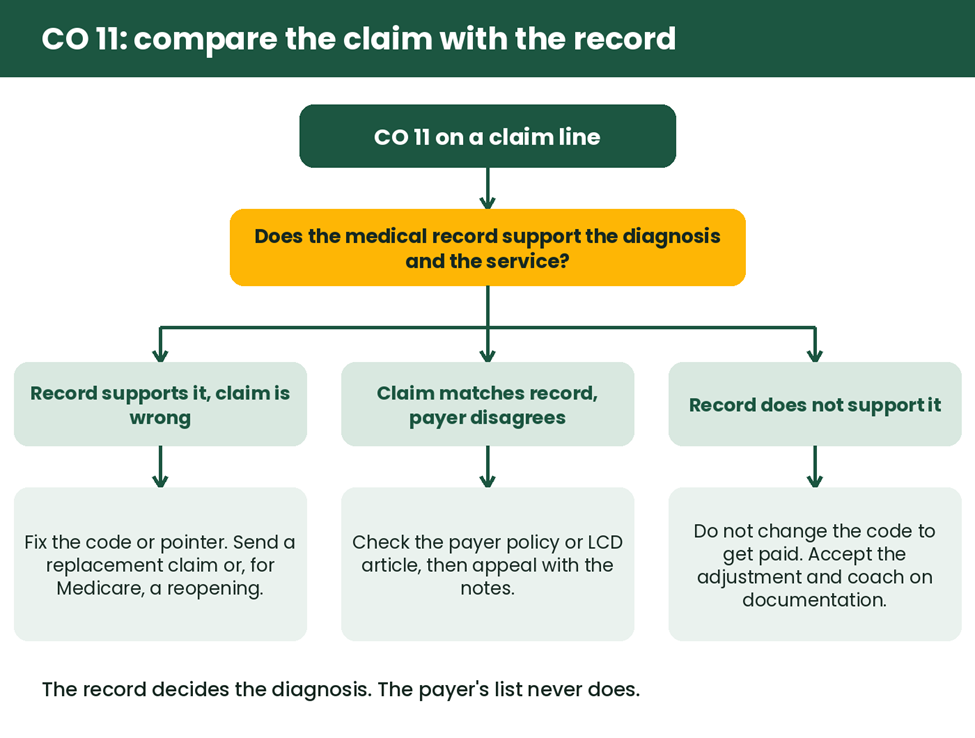
Diagram summary: if the record supports a different code or pointer, correct the claim; if the claim already matches the record, appeal with the notes; if the record does not support the service, accept the adjustment and fix documentation going forward.
- Open the denied line. Note the procedure code, every diagnosis it points to and any remittance advice remark code (RARC) on the line.
- Pull the visit note. Find the reason the provider documented for that specific service.
- Compare the claim with the note. Check the pointer first, then the code itself: is it the right condition, the right side and the right level of detail?
- If the claim is wrong, correct it. Fix the pointer or code and send a replacement claim with frequency code 7 and the original claim number. Our guide to [LINK: corrected claim frequency code 7 | /corrected-claim-frequency-code-7/] shows the fields. For Medicare Part B, use a reopening for this kind of clerical error.
- If the claim matches the note, check the payer’s policy. Confirm the diagnosis is on the payer’s list for that procedure. If it is, appeal with the note and the policy reference.
- If the note does not support the service, stop. Accept the adjustment. A provider query is fine to clarify unclear documentation, but it must not lead the provider toward a code that pays.
Example: a knee injection pointed to the wrong diagnosis
A practice bills a knee injection (CPT 20610) for a patient with right knee osteoarthritis and high blood pressure. Both diagnoses are on the claim, but the line points only to hypertension. The payer denies the line with CO 11.
The coder confirms the note documents the injection for right knee osteoarthritis, repoints the line to that diagnosis and sends a replacement claim. The lasting fix is a charge-entry rule: procedure lines must point to the condition being treated, not to whichever diagnosis is listed first.
How to Prevent CO 11 Denials
CO 11 is one of the most preventable denials, because every check can happen before the claim leaves the office.
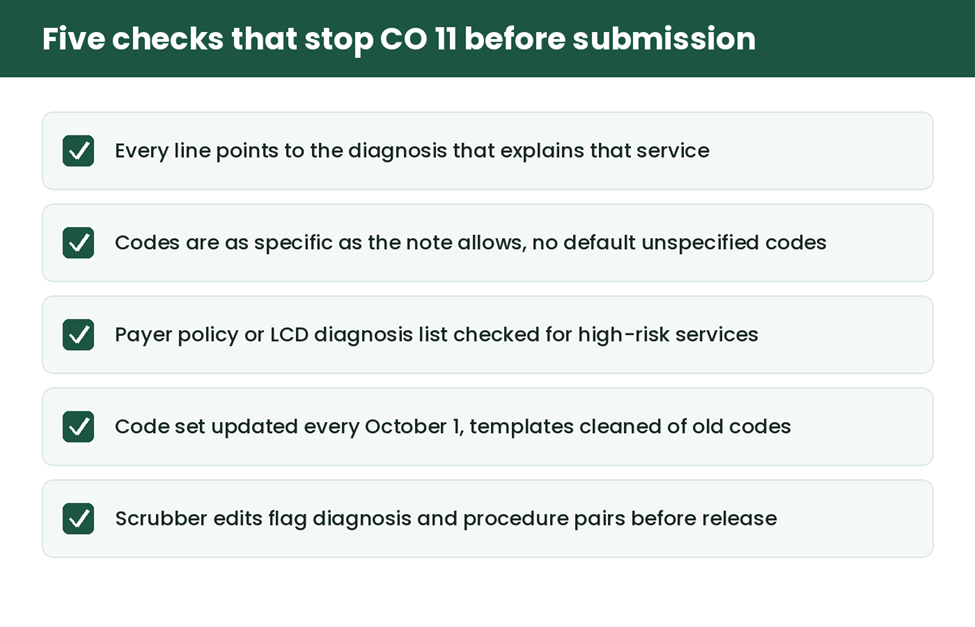
- Review diagnosis pointers on every line before release, especially on claims with several diagnoses.
- Code to the highest level of specificity the note supports, as the ICD-10-CM Official Guidelines for Coding and Reporting require. The FY 2027 code set and guidelines took effect October 1, 2026.
- Check the payer’s policy or LCD billing article before billing services that often deny, such as imaging, injections and lab panels.
- Update templates, order sets and charge rules every October 1 when the new ICD-10-CM codes take effect.
- Set claim scrubber edits that flag diagnosis and procedure pairs the payer has denied before.
- Track CO 11 by provider, procedure code and payer each month, and share the patterns with providers.
Get Help With Coding Denials
If CO 11 keeps coming back, the cause is usually a template, a charge rule or a documentation habit that one review can find. Our denial management services team can audit your recent CO 11 denials, correct the claims the record supports and show your team where the mismatches start.
Frequently Asked Questions
Is CO 11 a medical necessity denial?
Not exactly. CO 11 says the diagnosis on the claim does not fit the procedure it is linked to, which is often a coding or pointer error. A medical necessity denial says the payer does not consider the service necessary for the patient’s condition. The two overlap when a payer policy lists only certain diagnoses for a service.
Can I bill the patient for a CO 11 denial?
No. The CO group code makes the provider responsible for the denied amount. Fix the claim if the record supports a different code or pointer, or appeal if the claim is already correct. If neither applies, the adjustment is written off rather than moved to the patient.
Can I add a diagnosis after the claim is denied?
Only if the diagnosis was documented in the medical record for that visit. You can correct a missing or wrong code that the note already supports. You cannot add a condition the provider did not document, or ask the provider to add one only so the claim will pay.
Should I send a corrected claim or an appeal for CO 11?
Send a corrected claim when the claim itself was wrong, such as a bad pointer or code. Appeal when the claim matches the record and the payer’s edit or policy is the problem, and include the visit note. Our guide on [LINK: how to appeal a denied insurance claim | /how-to-appeal-a-denied-insurance-claim/] covers the appeal steps.
How many diagnoses can each claim line point to?
The CMS-1500 allows up to 12 diagnosis codes in item 21, labeled A through L. Most payers accept up to four pointers per service line in item 24E, listed with the primary reason first. Medicare contractors such as CGS ask for one primary pointer per line, so check each payer’s instructions.
Sources: X12 Claim Adjustment Reason Code list (as published in CMS reference data); CGS Medicare CMS-1500 form instructions; CMS Medicare Coverage Database; ICD-10-CM Official Guidelines for Coding and Reporting, FY 2027 (CDC/NCHS). This article is general billing information, not legal or coding advice for a specific case. Payer rules vary, so follow each payer’s provider manual.