
CO 151 is the denial payers send when the units or frequency billed are not supported.
The CO 151 denial code means the payer decided the claim does not support the number of units billed or how often the service was billed. Because it carries the CO (contractual obligation) group code, the practice absorbs the adjustment and cannot bill the patient. Below you will find the remark codes that travel with it, how Medicare’s unit edits trigger it, how to fix each type and how to prevent it.
CO 151 is one of the contractual codes covered in our [LINK: guide to CO denial codes and their meanings | /co-denial-codes-list/], and one of the few that questions the quantity rather than the service itself.
| Key takeaways CO 151 disputes the count or frequency of a service, not whether it is covered.The CO group code keeps the adjustment with the practice, never the patient.On Medicare claims, the MUE adjudication indicator decides whether you split lines, appeal or write off.Unit math, timed-code counting, missing modifiers and frequency limits cause most CO 151 denials. |
What Does the CO 151 Denial Code Mean?
CO 151 tells you the payer does not believe the claim supports this many services, or this frequency of services. Either too many units were billed for one date, or the service was billed more often than the payer’s policy allows in a set period. The service may still be covered; the payer is disputing the count, and the CO group makes any write-off the provider’s.
The official wording comes from the X12 Claim Adjustment Reason Codes list. CARC (Claim Adjustment Reason Code) 151 appears on the ERA (electronic remittance advice, the 835 file) and on the paper EOB (explanation of benefits).
Remark codes that often come with CO 151
A Remittance Advice Remark Code (RARC) adds detail to the CARC and tells you where to look first. Some payers send CO 151 alone; then start with units.
| RARC | What it tells you | What to check |
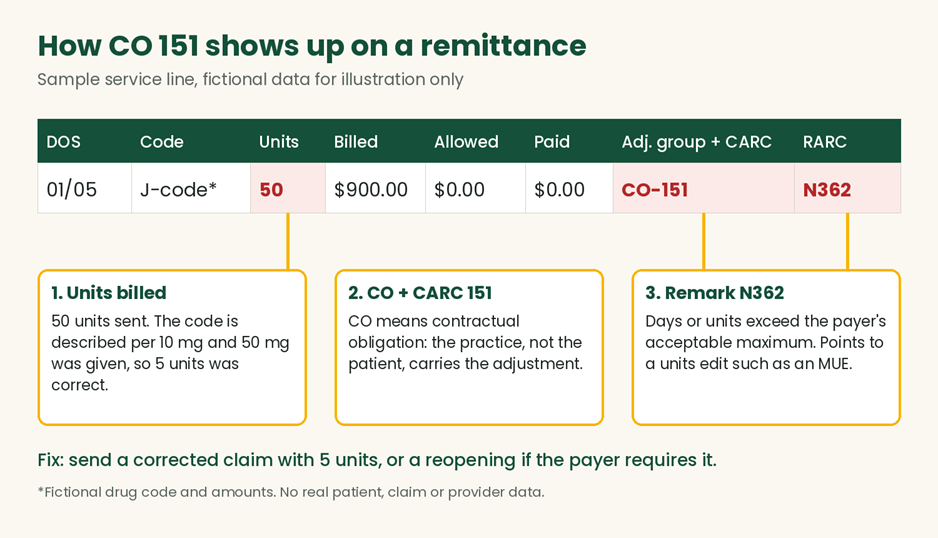
| N362 | Days or units exceed the payer’s acceptable maximum. | Units per line or per day against the MUE or payer cap. |
| N640 | Number or frequency exceeds what is allowed in a time period. | Plan visit limits and authorized visit count. |
| N115 | Decision based on a Local Coverage Determination (LCD). | Frequency limits in the LCD and policy article. |
| M86 | Same or similar procedure already paid within a set time frame. | Earlier claims, including same-or-similar DME. |
Why Payers Deny Claims with CO 151
- Units over a Medically Unlikely Edit (MUE). Medicare and many other payers cap the units per code, per patient, per date of service.
- Drug units entered as milligrams. HCPCS drug codes bill in the dose amount in the code descriptor, not total milligrams.
- Timed codes over-counted. Time-based codes bill in 15-minute units; see the [LINK: PT 8-minute rule for timed therapy units | /pt-8-minute-rule/] for the math.
- Units on the wrong number of lines. Stacking units on one line can break a per-line edit; repeating a line without a modifier looks like an error.
- Frequency or visit limits exceeded. Screenings, therapy visits and DME replacements often have per-period limits. If no authorization existed at all, payers usually send a CO 197 missing-authorization denial instead.
- Notes that do not show the count. Without each unit, site or session documented, an appeal has nothing to stand on.
How Medicare MUEs trigger CO 151
An MUE is the maximum units of service a provider would report for a HCPCS or CPT code for one patient on one date of service in most cases. CMS posts most values on its Medicare NCCI Medically Unlikely Edits page and updates them quarterly; some values stay confidential.
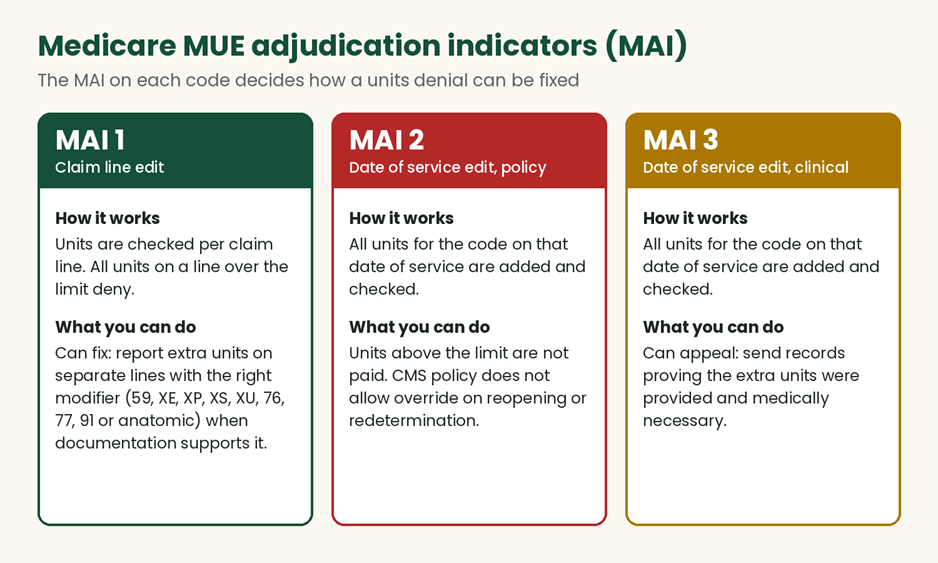
Each code carries an MUE adjudication indicator (MAI), explained in the Medicare NCCI Policy Manual, Chapter 1. When a line breaks a per-line edit, every unit on that line denies, not only the extra ones.
| MAI | How units are counted | What you can do |
| 1 | Per claim line. | Report supported extra units on a separate line with the right modifier. |
| 2 | Per date of service, based on policy. | Not payable above the limit, even on reopening or redetermination. Post the adjustment. |
| 3 | Per date of service, based on clinical benchmarks. | Appeal with records proving the units were provided and necessary. |
CMS treats an MUE denial as a coding denial, so an ABN (Advance Beneficiary Notice) cannot shift the units to the patient. Before splitting an MAI 1 line, review [LINK: when to use modifier 59 versus XE, XP, XS and XU | /modifier-59-vs-xe-xp-xs-xu/].
CO 151 vs Similar Denial Codes
| Code | What the payer is saying | First move |
| CO 151 | Units or frequency not supported. | Recount units; check MUE and frequency policy. |
| CO 150 | Level of service not supported. | Review documentation for the level billed. |
| 119 | Benefit maximum for the period reached. | Check plan limits; group code depends on the plan. |
| CO 18 | Exact duplicate claim or service. | Confirm duplicate vs valid repeat service. |
| CO 50 | Not deemed medically necessary. | Review diagnosis and necessity documentation. |
If the payer reads a second line as the same service twice, expect a CO 18 duplicate service denial instead. If it questions whether the service was needed at all, the CO 50 medical necessity code is more likely.
How to Fix a CO 151 Denial Step by Step
- Read the full line: CARC, group code, remark code, units billed and whether the whole line denied.
- Recount from the record: dose against the code descriptor, minutes for timed codes, and sites or sessions.
- Wrong units? Correct them. Commercial payers usually take a corrected claim; Medicare contractors handle many clerical unit errors through a reopening. See [LINK: corrected claim vs appeal | /corrected-claim-vs-appeal/] if unsure.
- Right units? Check the edit. MAI 1: split the line with a supported modifier (if the modifier itself is rejected, that becomes a CO 4 modifier denial). MAI 3: appeal. MAI 2: adjust off.
- Frequency policy? Read it. Confirm the limit, time window and authorization. If more care was needed, [LINK: appeal the denied claim | /how-to-appeal-a-denied-insurance-claim/] with notes and a medical necessity letter.
- Post and log it. Keep valid CO 151 adjustments off the patient balance and record the root cause.
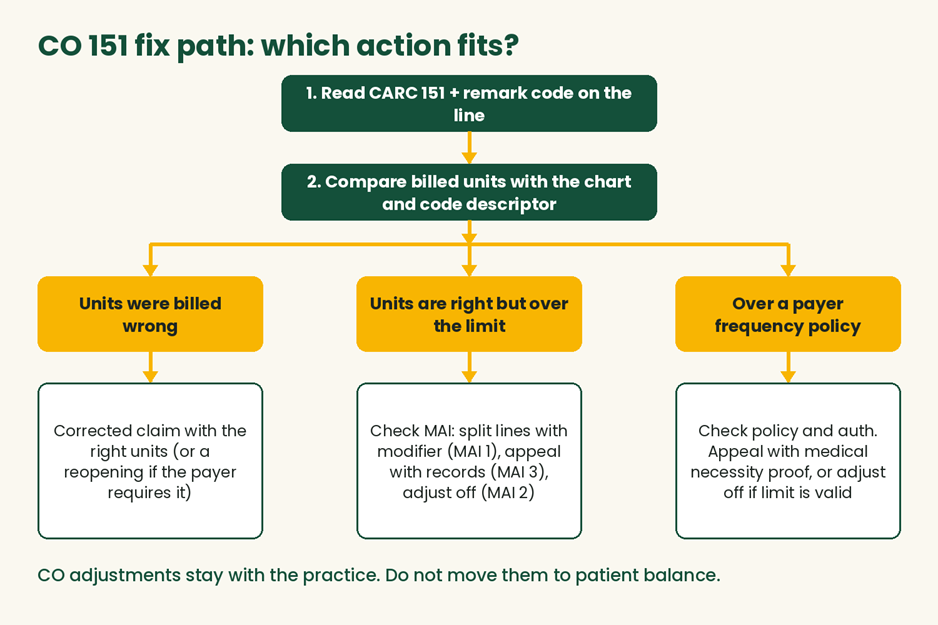
In short: wrong units get a correction, correct units over an MUE follow the MAI rule, and frequency denials need a policy check and, when justified, an appeal.
Example: two CO 151 denials (fictional)
Drug units. A clinic gave 50 mg of a drug coded per 10 mg but billed 50 units. The remit showed CO-151 with N362 and paid zero. Rebilling 5 units fixed it, and a charge master conversion stopped repeats.
Therapy visits. A PT practice billed visit 21 on a plan allowing 20 per year and got CO-151 with N640. It requested more visits and appealed with progress notes; without approval, the visit would be a valid write-off.
How to Prevent CO 151 Denials
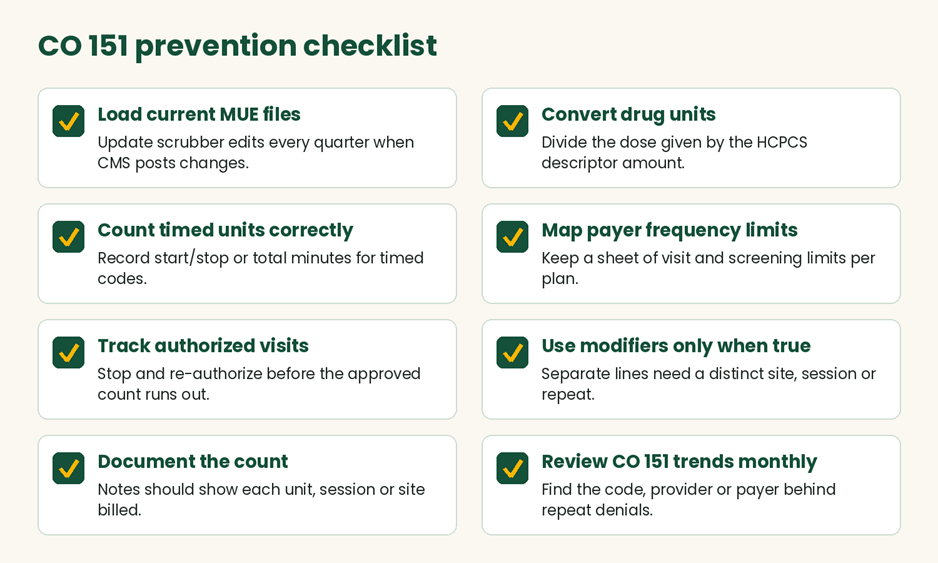
- Load current MUE files into your claim scrubber each quarter.
- Build drug unit conversions into the charge master.
- Record start and stop times or total minutes for timed codes.
- Keep a payer sheet of visit, screening and supply limits, and track authorized visits.
- Use modifiers only when the record shows a separate site, session or repeat.
- Review CO 151 trends monthly by code, provider and payer.
Repeat CO 151 denials on the same codes usually start in charge entry or coding, which a periodic audit by an experienced medical coding team can catch early.
Frequently Asked Questions About CO 151
Can I bill the patient for a CO 151 denial?
No. The CO group code makes the adjustment a contractual obligation the practice absorbs. For Medicare units denied by an MUE, CMS also bars billing the beneficiary, and an ABN does not change that because the denial counts as a coding denial. Only a PR (patient responsibility) group code allows billing the patient.
Can a CO 151 denial be appealed?
Usually, yes. If the units were correct and medically necessary, send records proving the quantity. On Medicare claims, MAI 3 edits can be overturned on appeal, but MAI 2 units cannot. If the first request fails, Medicare and most payers allow further appeal levels.
Is CO 151 a medical necessity denial?
Not exactly. CO 151 disputes how many times or how many units were billed, while a medical necessity denial disputes whether the service was needed at all. They overlap when a payer says extra units were not justified, so notes showing the clinical reason for each unit help in both cases.
Do commercial and Medicaid payers use CO 151?
Yes. CARC 151 is a national X12 code any payer can use. Commercial plans apply it to their own unit caps and visit limits, and many run MUE-style edits. CMS also maintains a separate NCCI program for Medicaid, so state Medicaid claims can deny for excess units in a similar way.
What is the difference between CO 151 and denial code 119?
CO 151 means the payer does not accept the count or frequency billed on the claim. Code 119 means the patient has already reached the plan’s benefit maximum for the period, such as a yearly visit cap. With 119, the group code depends on the plan, and the patient may owe the balance.
Get CO 151 Denials Off Your A/R
The CO 151 denial code is almost always fixable or preventable once you know whether units, an MUE or a frequency limit caused it. If these denials keep piling up, our denial management services team can work the backlog, trace root causes and set up front-end checks. Reach out whenever you want a second set of eyes.