
CO 167 is the denial payers send when the diagnosis billed is not covered for the service.
The CO 167 denial code means the payer will not pay for the service because the diagnosis on the claim is not covered for it. The CO (contractual obligation) group code puts the loss on the practice unless the claim is corrected, won on appeal or backed by a valid patient waiver. This guide covers the remark codes that point to the policy behind the denial, how CO 167 differs from look-alike codes, how to fix it and how to prevent it.
CO 167 belongs to the contractual group described in our [LINK: guide to CO denial codes and their meanings | /co-denial-codes-list/]. Unlike most of them, it turns on a single question: is this condition one the plan pays for with this service?
| Key takeaways CO 167 means the diagnosis billed is not on the payer’s covered list for that service.The remark code and policy ID on the remit tell you which NCD, LCD or plan policy applied.Fix it with a corrected claim only when the chart documents a covered diagnosis. Never add one that is not documented.For Medicare, a valid ABN signed before the service is what lets you bill the patient instead of writing it off. |
What Does the CO 167 Denial Code Mean?
CO 167 says the diagnosis, or every diagnosis, linked to the service is not covered. The service may be valid and coded correctly, but the payer’s coverage policy only pays for it when certain conditions are present. Because the group code is CO, the provider carries the adjustment and cannot shift it to the patient without a valid advance notice or plan rule that allows it.
The official wording sits in the X12 Claim Adjustment Reason Codes list, which also tells payers to point to the policy in the 835 remit’s policy identification segment when one applies. CARC (Claim Adjustment Reason Code) 167 appears on the ERA (electronic remittance advice) and the paper EOB (explanation of benefits).
Remark codes that point to the policy
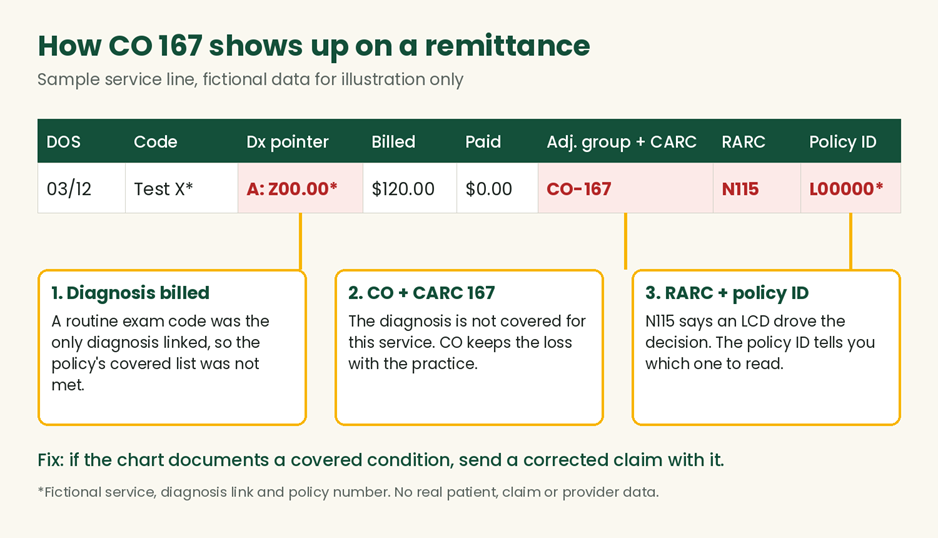
A Remittance Advice Remark Code (RARC) on the same line usually names the type of rule that caused the denial. That tells you which document to open.
| RARC | What it tells you | Where to look |
| N386 | The decision was based on a National Coverage Determination (NCD). | The NCD and its list of covered ICD-10 codes. |
| N115 | The decision was based on a Local Coverage Determination (LCD). | The LCD and its billing and coding article. |
| N130 | Check plan benefit documents for restrictions on this service. | The member’s plan documents or payer medical policy. |
| N425 | The service is statutorily excluded. | Whether the service is ever covered; an ABN is not required for exclusions. |
Why Payers Deny Claims with CO 167
- The diagnosis is not on the covered list. Many NCDs, LCDs and commercial policies list the exact ICD-10 codes that support a test or procedure.
- A vague code was billed. An unspecified code can fall outside the list even when the note describes a covered condition; see [LINK: when ICD-10 unspecified codes cause problems | /icd-10-unspecified-codes/].
- Screening billed against a diagnostic policy. A routine or screening diagnosis linked to a service that is only covered for symptoms or disease.
- Rule-out diagnoses coded as confirmed, or not coded at all. In outpatient settings the ICD-10-CM Official Guidelines say to code the signs and symptoms instead of a “rule out” condition, and those symptoms are often what the policy covers.
- Plan exclusions. Commercial and Medicaid plans can exclude conditions such as cosmetic or weight-related care, and rules vary by plan.
CO 167 vs Similar Diagnosis Denials
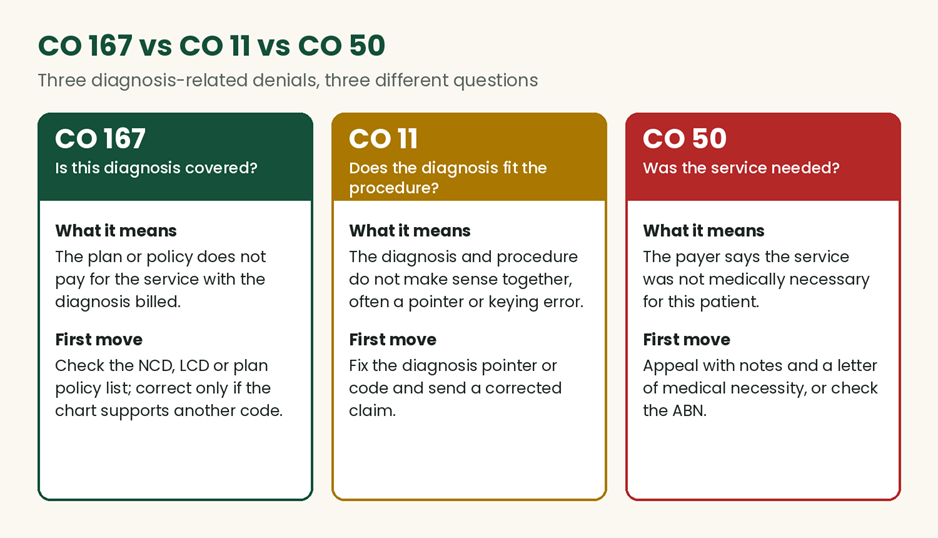
| Code | What the payer is saying | First move |
| CO 167 | This diagnosis is not covered for the service. | Read the policy; correct only if the chart supports a covered code. |
| CO 11 | The diagnosis does not fit the procedure. | Fix the pointer or code and send a corrected claim. |
| CO 50 | The service was not medically necessary. | Appeal with records or check for an ABN. |
| CO 96 | Non-covered charge; the remark code explains why. | Read the RARC to see what is excluded. |
| CO 146 | The diagnosis was invalid for the date of service. | Update to the code valid on that date. |
The two most confused codes are CO 167 and a CO 11 diagnosis-procedure mismatch. CO 11 usually means a keying or pointer error, while CO 167 is a coverage decision. When the denial is about the service rather than the diagnosis, it tends to arrive as the CO 50 medical necessity denial.
Some payers also send a general non-covered code for the same situation; our walkthrough of how to read a CO 96 non-covered charge covers that case.
How to Fix a CO 167 Denial Step by Step
- Find the policy. Note the remark code and any policy ID on the line, then pull that NCD, LCD or payer policy. For Medicare, search the Medicare Coverage Database.
- Compare the chart with the covered list. Read the provider’s note for every documented condition, not just the one that was coded.
- If a covered diagnosis is documented, correct the claim. Add or replace the diagnosis and fix the pointer. Unsure whether to correct or appeal? See [LINK: corrected claim vs appeal | /corrected-claim-vs-appeal/].
- If the diagnosis was covered all along, appeal. Quote the policy section and attach the notes. A short [LINK: medical necessity letter | /how-to-write-a-medical-necessity-letter/] helps when the payer misread the record.
- If it is truly not covered, check the waiver. With a valid Medicare ABN and the GA modifier, the patient can be billed; without one, post the CO adjustment.
- Log the root cause. Track the service, diagnosis and payer so the same gap is closed at the front end.
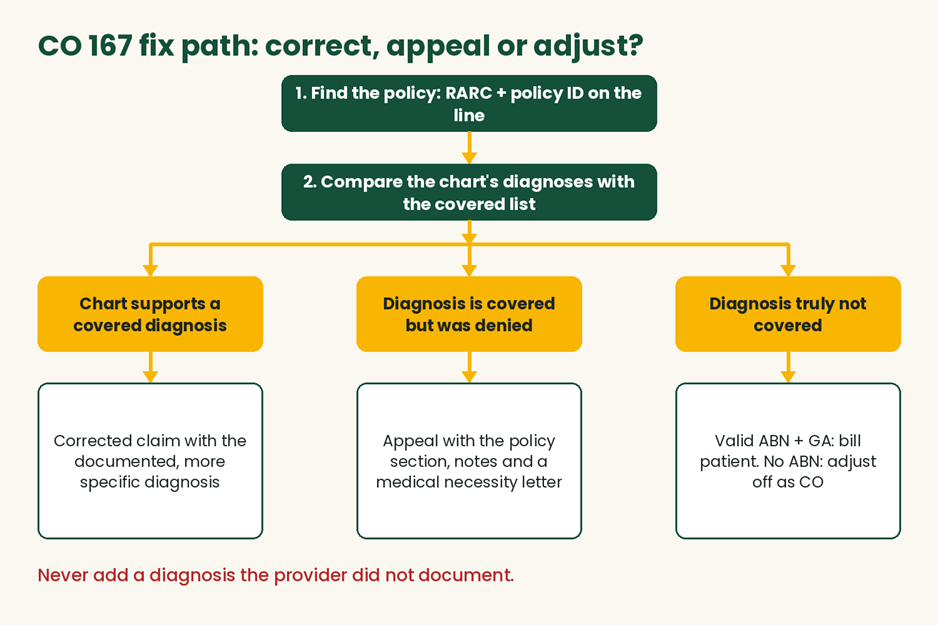
In short: a documented covered diagnosis means a corrected claim, a misapplied policy means an appeal, and a true exclusion means ABN-based patient billing or a write-off.
Compliance note: never add or change a diagnosis to match a coverage list unless the provider documented it. Ask the provider to review the note, and code only what the record supports.
Example: two CO 167 denials (fictional)
Missed diagnosis. A lab test was billed with only a routine exam code and came back CO-167 with N115. The note also documented a symptom on the LCD’s covered list. The coder added it as the primary diagnosis and the corrected claim paid.
True non-coverage. A Medicare patient wanted a test the LCD does not cover for their condition, and no ABN was signed. The denial stood as CO-167, so the practice wrote it off and added an ABN check to scheduling for that test.
How to Prevent CO 167 Denials
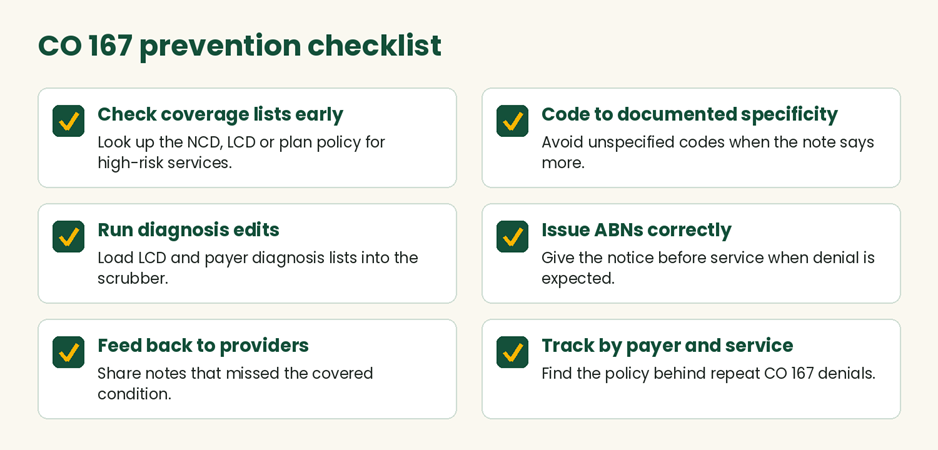
- Check the NCD, LCD or plan policy at scheduling for services with diagnosis limits.
- Code to the highest specificity the note supports, and train providers to document it.
- Load LCD and payer diagnosis lists into your claim scrubber.
- Give the Medicare ABN (Form CMS-R-131) before the service when a denial is expected, and append the matching [LINK: GA, GZ and GY modifiers | /modifier-ga-gz-gy/] correctly.
- Track CO 167 by payer, service and provider each month.
When the same diagnosis gaps keep coming back, a documentation and coding review by an experienced medical coding team usually closes them faster than appeals.
Frequently Asked Questions About CO 167
Can I bill the patient for a CO 167 denial?
Not with a CO group code. The adjustment is the practice’s unless a valid waiver shifts it. For Medicare, that means an ABN the patient signed before the service, reported with the GA modifier. For commercial plans, patient billing depends on the contract and any member waiver the plan allows.
What is the difference between CO 167 and PR 167?
The reason is the same: the diagnosis is not covered. The group code changes who pays. CO 167 leaves the balance with the provider, while PR 167 assigns it to the patient, which typically happens when a valid waiver, such as a signed Medicare ABN, was on file before the service.
Can I change the diagnosis to get the claim paid?
Only if the provider documented the new diagnosis in the record for that date of service. Adding or swapping a code just to meet a coverage list is a compliance risk. If the note is unclear, send a query to the provider and code only what the final documentation supports.
Can a CO 167 denial be appealed?
Yes, when the billed diagnosis is accurate and the payer’s policy actually covers it, or when the policy was applied to the wrong service. Attach the policy section, the provider’s notes and a short letter explaining why the criteria are met. If the condition is truly excluded, an appeal will not change the outcome.
Why did CO 167 show up when the service was medically necessary?
Coverage policies decide payment by listed diagnoses, not by the provider’s judgment alone. A necessary service still denies if the condition behind it is not on the payer’s list or was coded too vaguely to match. Reviewing the note for a more specific, documented diagnosis is the first step.
Get CO 167 Denials Under Control
The CO 167 denial code is a coverage decision, so the fix always starts with the policy and the chart. If diagnosis-related denials keep draining your A/R, our denial management services team can work the open claims, trace the policy gaps and set up front-end checks. Reach out whenever you want a second look.