
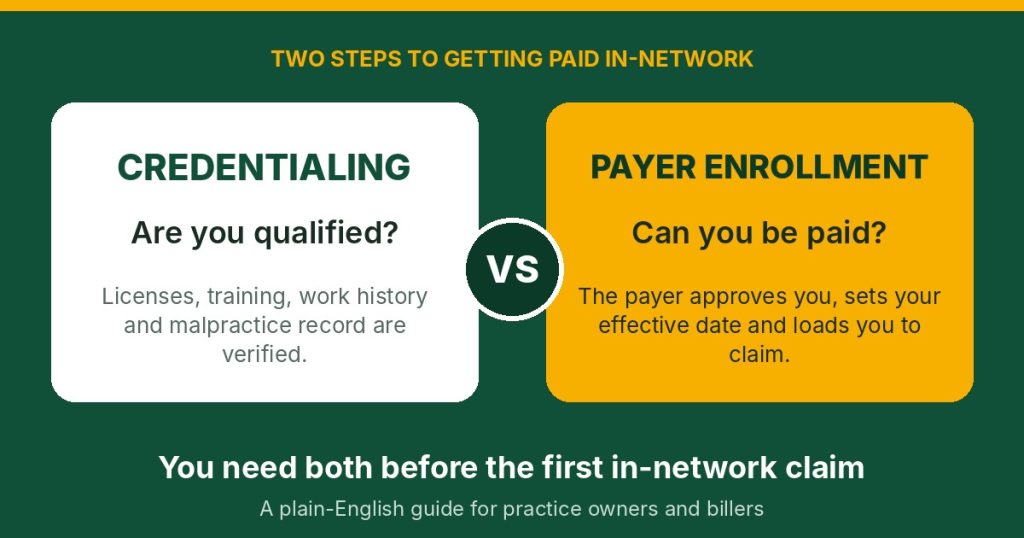
Credentialing verifies that a provider is qualified to practice. Payer enrollment gets that provider approved by a specific insurer so claims can be paid. A provider can pass credentialing and still be unable to bill a payer, because enrollment sets the participation status and effective date that claims depend on. This guide explains how the two differ, how they fit together, who handles each and how to keep both from delaying revenue. It is part of our payer enrollment guide for US practices.
Key takeaways
- Credentialing asks, “Is this provider qualified?” Payer enrollment asks, “Is this provider approved to bill and be paid by this payer?”
- Credentialing is verification. Enrollment is the application, participation status and effective date. Many payers run both in one file, so the words get mixed up.
- Approval is not the same as an effective date. Bill only for dates of service on or after the effective date in the payer’s written approval.
- Medicare, Medicaid and commercial plans each run enrollment differently. CAQH is shared data, not an approval.
Start both processes early, keep every record matching and track each payer separately.
What credentialing is and what it verifies
Credentialing is the process of confirming that a provider is who they say they are and is qualified to deliver care. The reviewer checks facts at the original source instead of taking the provider’s word for it. This is called primary source verification.
A typical credentialing file checks:
- State licensure and any license history
- Education, training and board certification, where applicable
- Work history, including explanations for gaps
- Malpractice claims history and current coverage
- Sanctions and exclusion checks against federal and state lists
Health plans credential providers for their own networks. Hospitals credential medical staff for privileges, which is a separate decision (see [LINK: credentialing vs privileging | /credentialing-vs-privileging/]). Some large groups and networks hold [LINK: delegated credentialing | /delegated-credentialing/], where the payer relies on the group’s review instead of repeating it.
Credentialing repeats. Plans that follow NCQA standards recredential practitioners every three years, which is covered in our re-credentialing guide.
For the full basics, read [LINK: what is provider credentialing | /what-is-provider-credentialing/], or see our credentialing services.
What payer enrollment is and what it produces
Payer enrollment is the application process that gets a provider approved to participate with a specific payer. You submit provider and practice details. The payer reviews them, sets up the provider in its systems and issues an effective date.
An enrollment package usually includes:
- Individual NPI (National Provider Identifier), group NPI and tax ID (TIN)
- Practice locations, specialty and taxonomy code
- License and, where relevant, DEA and board information
- CAQH ProView ID for most commercial payers, or a PECOS record for Medicare
- Payment setup such as EFT and ERA enrollment, and a reassignment form where a provider bills under a group
A finished enrollment gives you four things: participation status, a provider record in the payer’s claims system, a directory listing and, most important, an effective date.
For group billing, see [LINK: individual vs group payer enrollment | /individual-vs-group-payer-enrollment/] and [LINK: reassignment of benefits | /reassignment-of-benefits/].
Payer enrollment vs credentialing: side-by-side comparison
The table below shows where the two processes differ in purpose, ownership, output and renewal.
| Credentialing | Payer enrollment | |
| Main question | Is this provider qualified? | Is this provider approved to bill this payer? |
| What happens | Qualifications are verified at the source | An application is filed and participation and an effective date are set |
| Who decides | Payer credentialing committee, hospital or a verification organization | The payer, a Medicare contractor or a state Medicaid agency |
| Often handled by | Provider and a credentialing specialist | Billing, enrollment or RCM team |
| Key data sources | Primary sources and the CAQH profile | Payer applications, PECOS for Medicare, state portals |
| Output | A credentialing decision | Participation status, provider record and effective date |
| Renewal | About every three years under NCQA standards; CAQH re-attestation every 120 days | As each payer or program requires; Medicare revalidation for most providers every five years |
| If it goes wrong | Network application delayed or denied | Claims denied, paid out of network or unpayable for dates before the effective date |
Where payer contracting fits
Commercial payers add a third piece: the contract that sets reimbursement rates and terms. Some payers handle credentialing, enrollment and contracting in one workflow. Others split them. Medicare pays under a fee schedule, so it has enrollment without rate negotiation. Learn more in [LINK: what is payer contracting | /what-is-payer-contracting/] and our payer contracting services.
Why the terms get mixed up
Payers use different words for overlapping steps. One calls the whole process credentialing. Another calls it enrollment, participation or contracting. Ask each payer which steps and documents it requires and what it calls them, then track those steps in your own words.
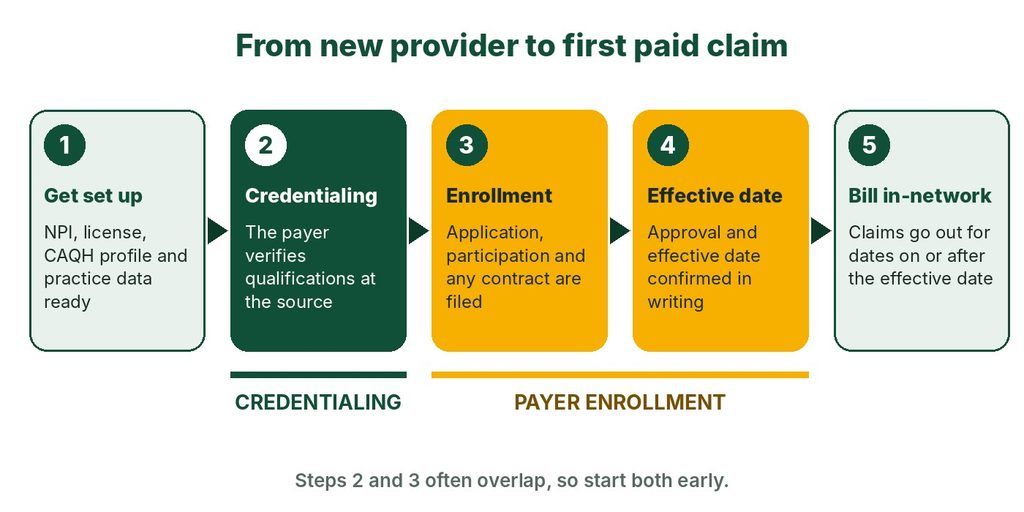
In short: the path runs from setup, to credentialing, to enrollment, to a written effective date, and only then to billing.
Follow these steps for each new provider:
- Confirm identifiers: individual NPI, group NPI, TIN, license and taxonomy.
- Build or update the CAQH ProView profile, attest it and authorize each payer (see CAQH and PECOS help).
- Submit each payer’s application. For Medicare, use PECOS or the CMS-855 form.
- Answer payer requests quickly and follow up on a set schedule.
- Get the approval and effective date in writing.
- Load the provider in your billing system, then test with a clean claim.
- Calendar every re-attestation, revalidation and recredentialing date.
Which comes first? For commercial payers, the credentialing decision generally precedes final participation, but practices should not wait. File in parallel and let each payer run its own sequence. Medicare enrollment has its own federal screening and does not wait on commercial credentialing.
Who does the work in a practice
Credentialing is performed by the payer’s team, a hospital medical staff office or a verification organization. Your side supplies the documents. Enrollment applications are usually prepared by billing or enrollment staff, or an outsourced RCM partner, because the data feeds claims setup. Either way, name one owner and keep a tracker so files do not sit idle.
How Medicare, Medicaid and commercial plans differ
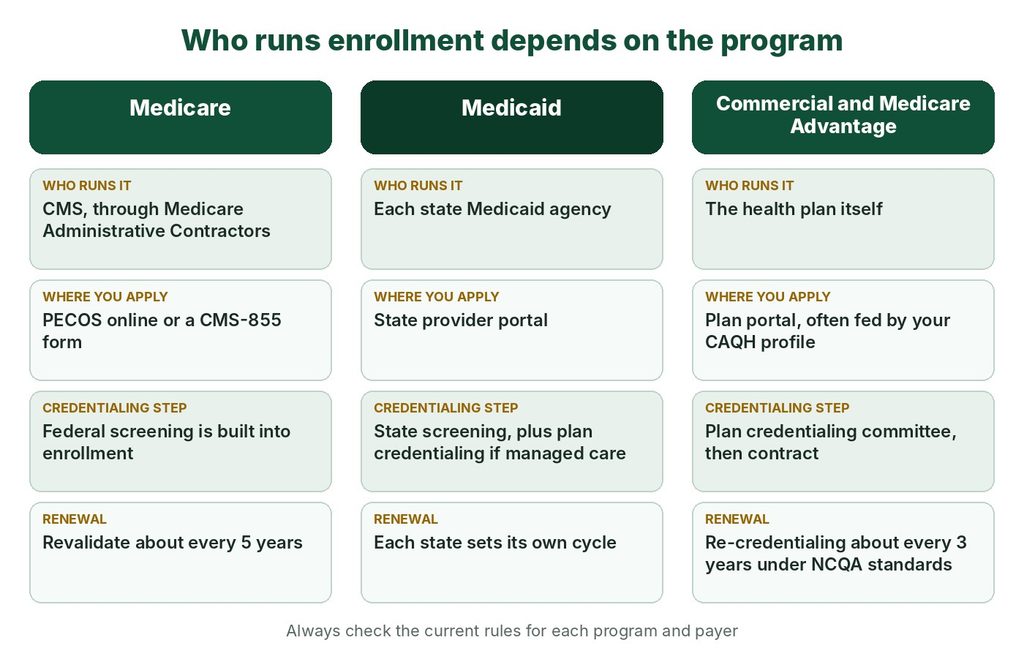
In short: Medicare is run by CMS contractors, Medicaid by each state, and commercial plans by the plans themselves.
Medicare
Providers enroll through PECOS or CMS-855 forms. For physicians and many practitioners, the effective date is generally the later of the filing date of an application that is later approved or the date services began at the new location. Medicare also allows limited retrospective billing, up to 30 days before the effective date in some situations and up to 90 days when a Presidentially declared disaster prevented enrollment (42 CFR 424.520 and 424.521). Most providers revalidate every five years, and DMEPOS suppliers every three, per CMS. See [LINK: what is PECOS | /what-is-pecos/] and [LINK: Medicare revalidation | /medicare-revalidation/].
Medicaid
Each state runs its own Medicaid enrollment, screening and revalidation. Managed care plans add their own credentialing and contracts on top. Details are in [LINK: Medicaid provider enrollment process | /medicaid-provider-enrollment-process/] and [LINK: Medicaid managed care enrollment | /medicaid-managed-care-enrollment/].
Commercial plans and Medicare Advantage
Each plan has its own application, usually drawing on the CAQH profile, followed by credentialing review and a contract. Medicare Advantage networks are separate from original Medicare enrollment.
See [LINK: Medicare Advantage enrollment for providers | /medicare-advantage-enrollment-for-providers/] and [LINK: telehealth payer enrollment | /telehealth-payer-enrollment/].
Timelines, effective dates and renewals
No single timeline applies. Each payer sets its own review steps and targets in its provider manual, states shape Medicaid, and an incomplete application restarts the clock. Plan for several months, and begin before the provider’s start date.
See [LINK: how long does payer enrollment take | /how-long-does-payer-enrollment-take/].
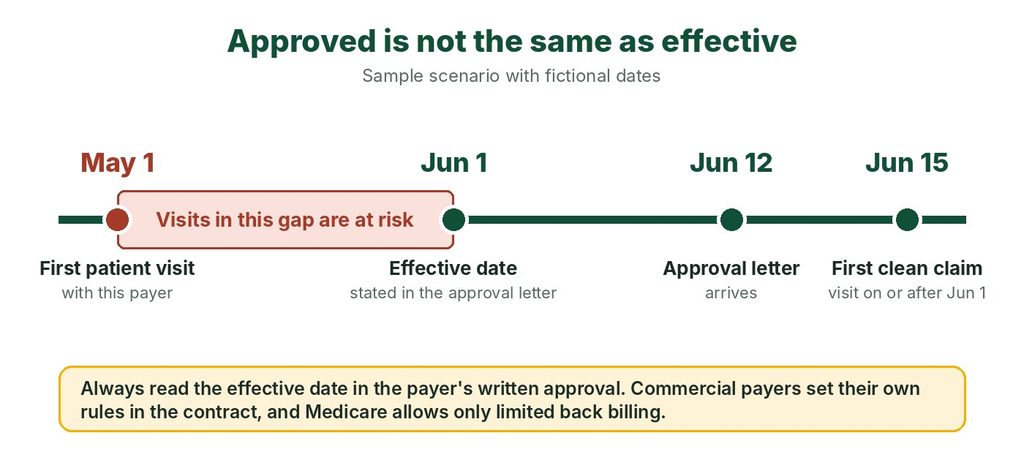
In short: the approval letter can arrive after the effective date, and visits before that date are the ones at risk.
Treat the written effective date as the source of truth. Commercial payers set their own rules in the contract and provider manual, and many will not pay for earlier dates of service. Read more in [LINK: payer enrollment effective date | /payer-enrollment-effective-date/].
Calendar these renewal cycles from day one:
| Item | Cycle | Source |
| CAQH ProView attestation | Every 120 days | CAQH |
| Plan recredentialing | About every three years where NCQA standards apply | NCQA |
| Medicare revalidation | Most providers every five years; DMEPOS suppliers every three | CMS |
| Medicaid and other payers | Set by the state or the payer manual | State or payer |
Example (fictional). A family medicine group hires a physician who starts June 1. In March, the practice updates the CAQH profile and files applications. One payer returns the file because the suite number differs from the NPI record. The team fixes the record, resubmits and tracks the new status weekly. That payer’s approval arrives mid-June with a June 1 effective date, so the practice schedules that payer’s patients for June 1 or later and holds earlier claims until the written date is confirmed.
Keep provider records consistent
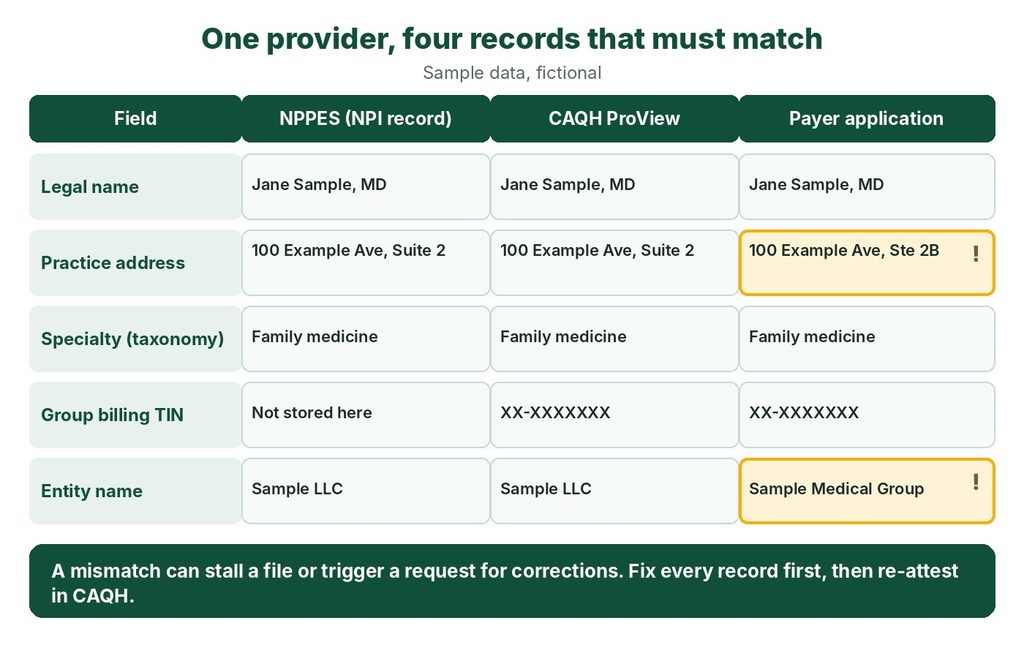
Payers compare your application with the NPI record, the CAQH profile and sometimes PECOS. Names, addresses, taxonomy and tax IDs should match everywhere before you submit. Fix every record first, then re-attest in CAQH.
See [LINK: NPI vs CAQH ID | /npi-vs-caqh-id/] and our CAQH and PECOS services.
Common mistakes and how to prevent them
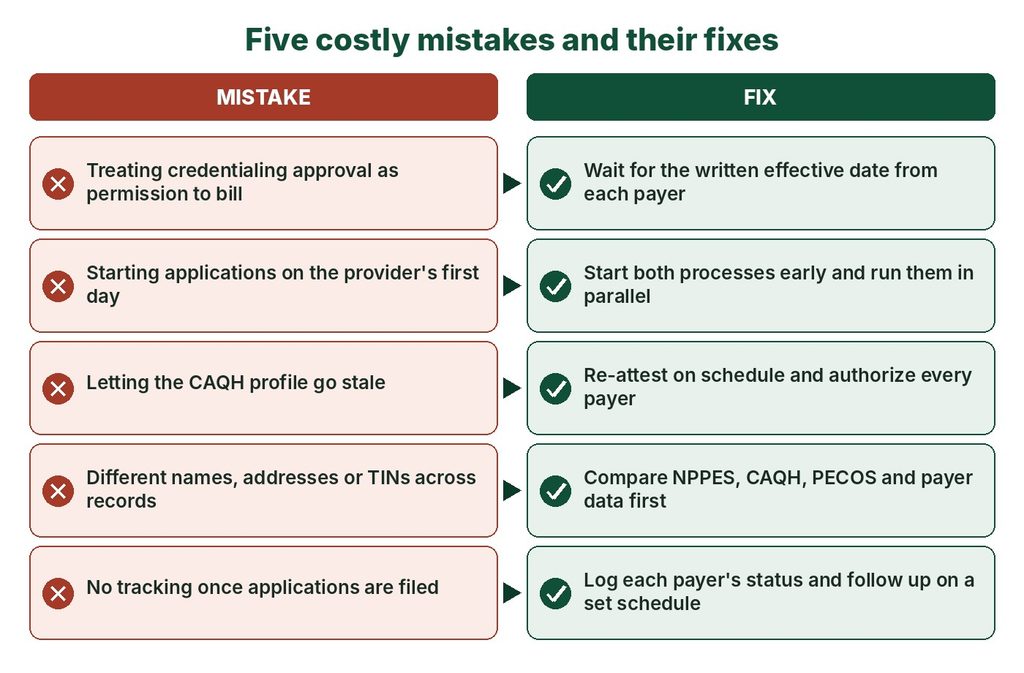
Mistakes here become denials later. A claim submitted for an unenrolled provider can be denied or paid out of network, which sends it into denial management.
Our guide to [LINK: payer enrollment mistakes | /payer-enrollment-mistakes/] goes deeper.
Checklist before the first patient visit
- Credentialing approved or in progress for each payer on the panel
- Enrollment application filed for each payer, with a confirmation or tracking number
- Written approval and effective date saved for each payer
- CAQH profile attested, documents current and payers authorized
- Provider loaded in the billing system with the right NPI, TIN and payer IDs
- Clean test claim reviewed before volume starts
- Renewal dates calendared
Use our [LINK: payer enrollment checklist | /payer-enrollment-checklist/] for the full version.
Explore the payer enrollment cluster
These guides go deeper on each part of enrollment. Together with this article, they form a complete path from application to revalidation.
{LINK}: payer enrollment process step by step | /payer-enrollment-process-step-by-step/] A full walkthrough from gathering documents to the approval letter, with the forms and portals each payer type uses.
[LINK: how long payer enrollment takes | /how-long-does-payer-enrollment-take/] What drives timelines and how to start early enough that a new provider can bill on day one.
{LINK}: individual vs group enrollment | /individual-vs-group-payer-enrollment/] When a provider enrolls alone, when they enroll under a group, and how NPI and tax ID relationships change what you file.
[LINK: adding a provider to a group contract | /how-to-add-a-provider-to-a-group-contract/] The steps and documents for adding a clinician to an existing group agreement and updating the roster.
[LINK: reassignment of benefits | /reassignment-of-benefits/]
How a provider assigns Medicare payments to a group, why the CMS-855R matters and what breaks without it.
LINK: Medicaid enrollment process | /medicaid-provider-enrollment-process/] How state programs enroll providers, what screening to expect and why rules differ by state.
[LINK: Medicaid managed care enrollment | /medicaid-managed-care-enrollment/] How plan credentialing and contracting work on top of state Medicaid enrollment.
[LINK}: Medicare Advantage network enrollment | /medicare-advantage-enrollment-for-providers/] How to join Medicare Advantage plan networks, which are separate from original Medicare.
LINK: telehealth enrollment requirements | /telehealth-payer-enrollment/] Extra details payers may ask for when care is delivered by telehealth.
[LINK: enrollment mistakes to avoid | /payer-enrollment-mistakes/] The errors behind most rejections and delays, with fixes for each.
{LINK}: enrollment checklist | /payer-enrollment-checklist/] What to gather and confirm before you submit any application.
LINK: effective dates explained | /payer-enrollment-effective-date/] How effective dates are set, why they differ from approval dates and how to protect revenue.
LINK: payer revalidation | /payer-revalidation/] How payers confirm your data on a schedule and what happens when a deadline is missed.
Frequently asked questions
Is payer enrollment the same as credentialing?
No. Credentialing verifies a provider’s qualifications. Payer enrollment gets the provider approved and set up with a payer so claims can be paid. Payers often run both in one file, so they use the terms loosely. Ask each payer which steps and documents it requires, and what it calls them.
Which comes first, credentialing or enrollment?
Commercial payers generally finish credentialing before a provider becomes participating, but practices should file in parallel and track each payer separately. Medicare runs through its own enrollment process, which includes federal screening, and does not wait on commercial credentialing. Start as early as you can.
Can a provider see patients before enrollment is approved?
A provider can treat patients, but payment is the risk. Commercial payers set their own rules in the contract and provider manual, and many will not pay for dates of service before the effective date. Medicare allows only limited retrospective billing. Check each payer’s rules and schedule that payer’s patients accordingly.
Is CAQH credentialing or enrollment?
Neither. CAQH ProView is a shared data profile that many commercial payers use during credentialing. Completing and attesting it does not approve a provider, because each payer still reviews the profile and decides. Providers re-attest every 120 days and must authorize each payer to view the profile.
Is payer contracting the same as enrollment?
No. Contracting sets the agreement and rates between a practice and a commercial payer. Enrollment sets up the provider under that agreement or program. Some payers combine them in one process. Medicare pays under a fee schedule, so it has enrollment without rate negotiation.
How often do credentialing and enrollment need renewal?
CAQH profiles need re-attestation every 120 days. Plans that follow NCQA standards recredential practitioners about every three years. Most Medicare providers revalidate every five years, and DMEPOS suppliers every three. Medicaid and commercial cycles follow state rules or payer manuals, so calendar every date.
Get both processes moving
Understanding payer enrollment vs credentialing helps you plan start dates, protect cash flow and avoid claims that cannot be paid. If your team would rather hand off the paperwork, Medfix can handle applications, follow-up and effective-date confirmation through our payer enrollment services and credentialing services. You can also see how enrollment fits into your wider revenue cycle management. Talk with us when you are ready. There is no pressure.
Sources and note: CMS (42 CFR 424.520, 424.521 and Medicare revalidation guidance), CAQH ProView provider guidance and NCQA credentialing standards. This article is general education, not legal advice, and payer rules vary by contract.