
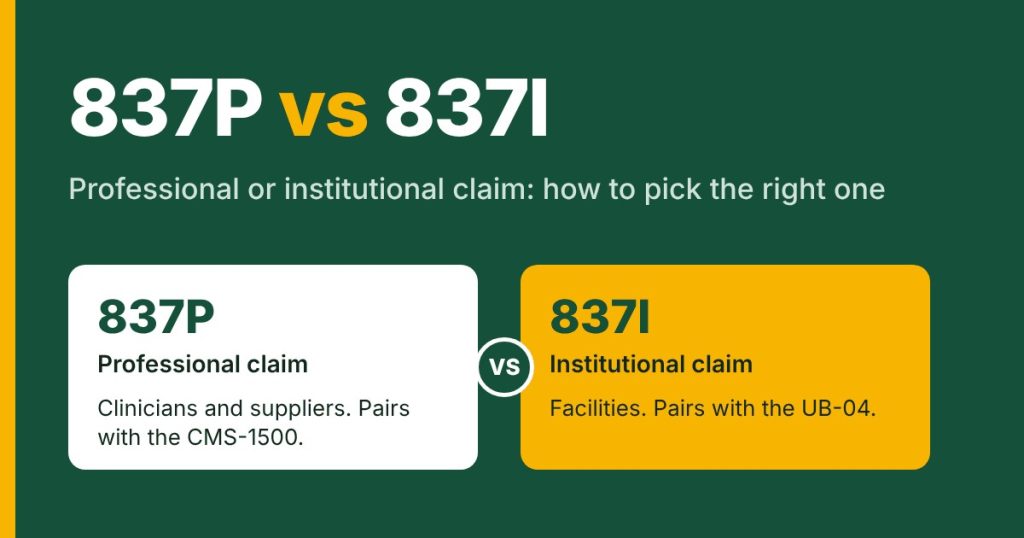
The 837P is the electronic professional claim used by physicians, practitioners and suppliers, and it is the electronic counterpart of the CMS-1500. The 837I is the electronic institutional claim used by facilities such as hospitals and skilled nursing facilities, and it matches the UB-04 (CMS-1450). Choosing between 837P vs 837I depends on who is billing, not on the service itself. This guide shows how the two differ and how to pick the right one.
| Key takeaways The 837P is for clinicians and suppliers and pairs with the CMS-1500. The 837I is for facilities and pairs with the UB-04.Pick the claim type by who is billing, not by what was done.One visit can need both: the facility bills on an 837I and the clinician bills on an 837P.Institutional claims add type of bill and revenue codes. Professional claims use CPT or HCPCS codes, modifiers and place of service. |
837P vs 837I: The Core Differences
The 837P carries a professional claim for a clinician’s or supplier’s own services, and the 837I carries an institutional claim for a facility’s services. The 837P pairs with the CMS-1500 and the 837I with the UB-04 (CMS-1450). Both are HIPAA-standard X12 837 transactions, but each follows its own version of the standard with different required data.
If you are new to the paper form behind the 837P, start with [LINK: how to complete the CMS-1500 | /cms-1500-form-instructions/]. The electronic claim carries the same kind of professional billing data in a standard file format.
| Feature | 837P (professional) | 837I (institutional) |
| Used by | Physicians, nurse practitioners, physician assistants, therapists, chiropractors, clinical psychologists, clinical social workers, ambulance services and other suppliers | Hospitals, critical access hospitals, skilled nursing facilities, home health agencies, hospices, FQHCs, rural health clinics and ESRD facilities |
| Paper counterpart | CMS-1500 | CMS-1450 (UB-04) |
| Medicare format version | X12 837P, version 5010A1 | X12 837I, version 5010A2 |
| Procedure coding | CPT and HCPCS codes with modifiers | HCPCS for most outpatient services; ICD-10-PCS for inpatient facility procedures on Medicare Part A claims |
| Setting and facility codes | Place of service code | Type of bill and revenue codes maintained by the NUBC |
| Medicare paper exception (ASCA) | Fewer than 10 full-time equivalent employees | Fewer than 25 full-time equivalent employees |
Table note: version numbers and exceptions are for Medicare and come from the CMS booklet Medicare Billing: CMS-1500 & 837P and its institutional companion. Other payers set their own rules in their provider manuals and companion guides.
For the two paper forms side by side, see [LINK: UB-04 vs CMS-1500 | /ub-04-vs-cms-1500/].
Who Bills Each Claim?
The test is who provided the service and how the payer has set that provider up, not the type of service. A surgeon’s own work goes on an 837P. The hospital or surgery center’s facility work goes on an 837I.
Some clinics surprise billing teams. For Medicare, CMS lists federally qualified health centers (FQHCs) and rural health clinics among institutional provider types, so they bill on the 837I rather than the 837P. Other payers can classify the same provider differently, so confirm the claim type in each payer’s provider manual or companion guide.
The code sets behind each claim also differ. If your team needs help keeping them straight, our team handles medical coding alongside billing.
One Visit, Two Claims
Take a fictional outpatient surgery at a hospital. The hospital bills for the operating room, nursing and supplies on an 837I, using a type of bill and revenue codes. The surgeon bills for the procedure on a separate 837P, using CPT or HCPCS codes, modifiers and a place of service code. The payer processes the two claims separately. Each returns its own remittance, a transaction explained in [LINK: 837 vs 835 EDI transactions | /837-vs-835-edi-transactions/].
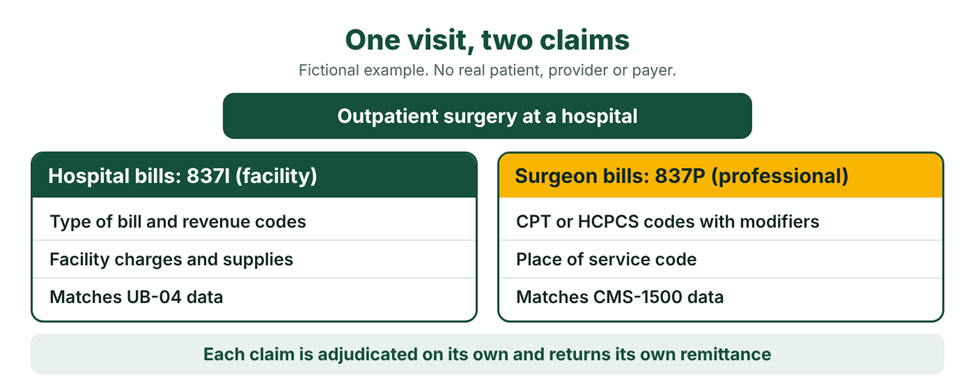
Summary of the diagram: one hospital outpatient surgery produces a facility claim on the 837I and a professional claim on the 837P, each with its own codes and its own remittance.
How to Choose the Right Claim
Use this routine before a claim leaves your office:
- Identify who is billing: a clinician or supplier, or a facility.
- Match the claim to the billing data: CMS-1500 data goes on an 837P, and UB-04 data goes on an 837I.
- Code the claim for its type: CPT or HCPCS, modifiers and place of service for professional claims, and type of bill and revenue codes for institutional claims.
- Check how the payer has enrolled and classified the provider, especially for clinics and hospital-based practices.
- Confirm your [LINK: clearinghouse | /what-is-a-clearinghouse-in-medical-billing/] supports both transaction types.
- File electronically. Medicare expects initial claims to be submitted electronically unless the provider qualifies for an exception or waiver.
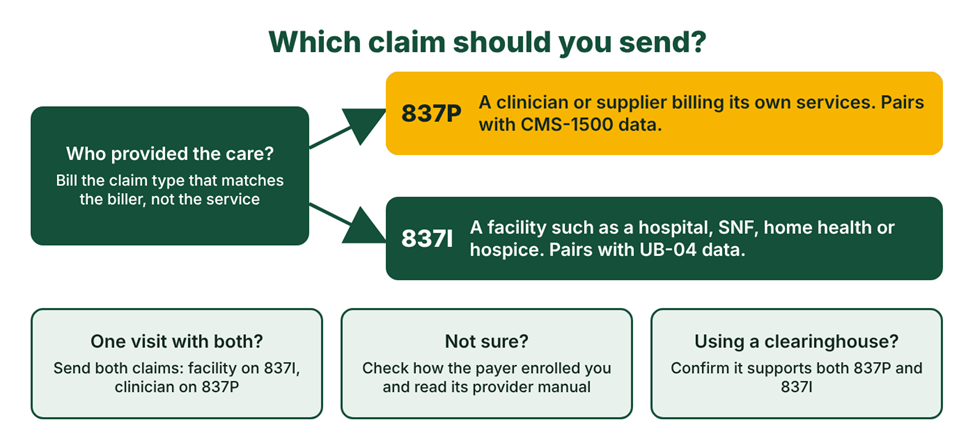
Summary of the chart: if a clinician or supplier is billing, send an 837P; if a facility is billing, send an 837I; if one visit involves both, send both; and when unsure, check the payer’s enrollment and manual.
Common Claim Type Mistakes and Fixes
Most errors come from choosing by service instead of by biller. The chart pairs six frequent mistakes with a fix.
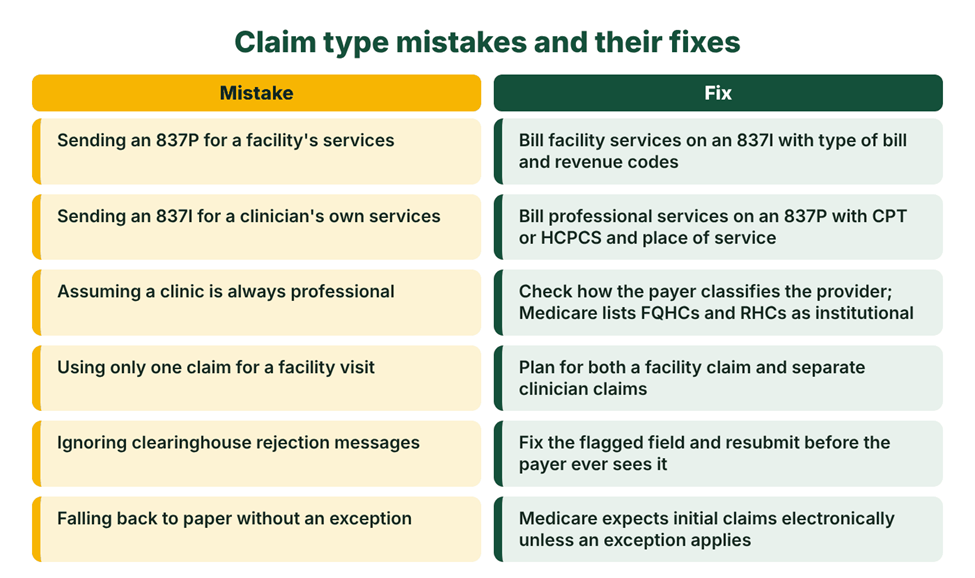
Summary of the chart: use an 837I for facilities and an 837P for clinicians, plan for two claims on a facility visit, watch clearinghouse rejections, and avoid paper without an exception.
A wrong or incomplete claim often stops at the clearinghouse or payer front end as a rejection, before adjudication. Once a claim is processed, missing required data can come back as a denial such as [LINK: claims denied for missing information | /co-16-denial-code/]. Fix the data, correct the claim type if needed, and resubmit.
Frequently Asked Questions
Is the 837P the same as the CMS-1500?
They carry the same kind of professional claim in different formats. The CMS-1500 is the paper form, and the 837P is the electronic transaction. Medicare expects initial claims to be submitted electronically unless the provider qualifies for an exception under the Administrative Simplification Compliance Act (ASCA), so most practices send the 837P instead of paper.
Can a hospital send an 837P?
Hospitals bill facility services on the 837I. A physician employed by a hospital usually bills professional services on an 837P through a separate billing setup, and that setup varies by payer and enrollment. Check with the payer before changing claim type, because sending the wrong type can cause rejections.
Do FQHCs and rural health clinics use the 837I?
For Medicare, CMS lists FQHCs and rural health clinics among institutional provider types, so they submit the 837I. Other payers can differ, and state Medicaid programs have their own billing rules. Confirm the claim type in each payer’s provider manual or companion guide before you submit.
What codes differ between the two claims?
Professional claims use CPT and HCPCS procedure codes with modifiers and a place of service code. Institutional claims add type of bill and revenue codes, and Medicare uses ICD-10-PCS for inpatient facility procedures. Problems tied to these fields often show up in denial management work later.
What comes back after I send either claim?
Payers answer both claim types with an electronic remittance advice, the 835. Each claim gets its own remittance, so a hospital stay and a surgeon’s bill post separately. For how that document differs from a patient statement, see [LINK: ERA vs EOB | /era-vs-eob/].
Get a Second Look at Your Claim Setup
Choosing between 837P vs 837I is a small decision that touches coding, enrollment and clearinghouse setup. If your team bills both professional and facility claims and wants a second look at how they are set up, Medfix Billing Services can help. You can learn more about our medical billing services whenever it is useful, with no obligation.
Sources: CMS MLN booklets Medicare Billing: CMS-1500 & 837P and Medicare Billing: CMS-1450 & 837I; CMS MLN course lessons on the 837P and 837I electronic claims. Payer rules vary, so check each payer’s provider manual. This article is general education, not legal advice.